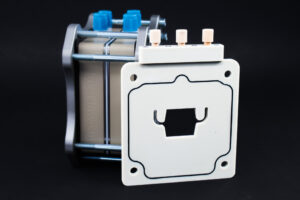
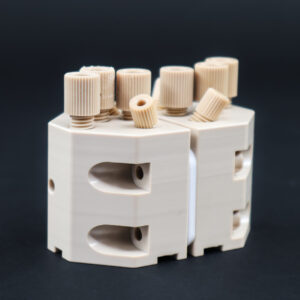
Electrolysis Flow Cells and Accessories for R&D
Advancing Electrolysis R&D with Modular Flow Cells
Our electrolysis product line supports cutting-edge research in water splitting, hydrogen production, catalyst testing, and emerging electrolysis technologies. Our electrochemical flow cells and components are designed to be flexible and modular — engineered for electrolyzer R&D that lets you test new membranes, electrodes, catalyst materials, or electrolyte solutions. Our setups are compatible with alkaline, AEM, PEM, and CO₂ electrolysis systems, as well as desalination and electrodialysis, and are scalable from catalyst screening at the 1 cm² level to system-level validation with multi-cell stacks.
Whether you’re screening catalysts for alkaline water electrolysis, testing membranes for AEM or PEM systems, or exploring CO₂ reduction and electrodialysis, our platform gives you a single hardware ecosystem that adapts to your chemistry — not the other way around.
Supported Electrolysis Chemistries
Our flow-cell systems and components integrate into a wide range of electrolysis setups:
- Alkaline Water Electrolysis (AWE): For established, cost-effective hydrogen production platforms and new diaphragm development and testing. Our alkaline water electrolysis platform supports AWE research across catalyst, membrane, and bipolar-plate development.
- Anion Exchange Membrane (AEM) electrolysis: Combining the advantages of alkaline chemistry with membrane-based operation. Our AEM electrolysis configuration enables the use of non-precious-metal catalysts.
- Proton Exchange Membrane (PEM) electrolysis: For compact, high-efficiency hydrogen generation under clean water and acidic conditions. Standard and custom MEAs (membrane electrode assemblies) are supported.
- CO₂ Electroreduction (CO2RR): For electrochemical CO₂ reduction research — converting CO₂ into valuable chemicals and fuels on a flexible platform for testing different electrodes, membranes, and process concepts.
- Desalination: For electrochemical water treatment and salt removal research, including brackish water desalination via electrodialysis and capacitive deionization (CDI).
- Electrodialysis (ED): For ion-selective membrane separation research.
- Other Electrolysis Processes: For ion transport studies, selective ion separation, resource recovery, and coupled electrochemical separation/reaction systems on modular multi-compartment cell platforms.
Lab-Scale Electrolyzer Cells, Components & Accessories
Our research electrolysis cells and components are organized into two main groups: core flow cells and supporting accessories.
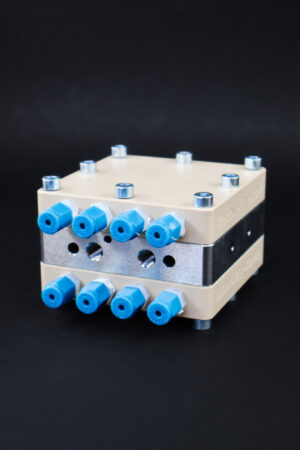
Flow cells and stacks
Components and consumables
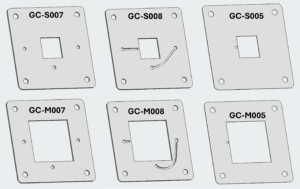
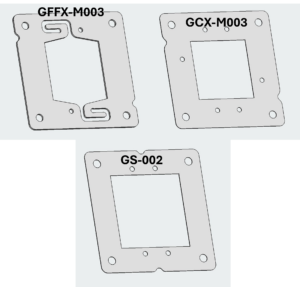
- High-precision gasket solutions
- Robust current collectors & bipolar plates in a wide variety of materials
- X-Cell: Ni, Ti, 316L SS, Cu, Pt-Ti, Au-Ti
- X-Stack + X-Stack w. FF: Ni, Ti, SS (bipolar plates)
- M-Cell: Graphite, Ni, Ti, 316L SS
- A wide selection of electrodes and membranes
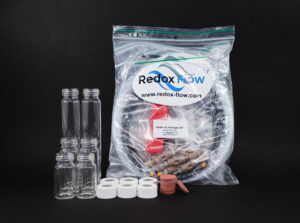
Accessories for fluid handling and inline measurement
Electrolysis Research Applications
Our electrolysis components are used globally by researchers and engineers working on:
- Catalyst development and screening for hydrogen evolution, oxygen evolution, and CO₂ reduction
- Membrane evaluation across AEM, PEM, and hybrid systems
- Gas-diffusion electrode (GDE) testing
- General electrolysis applications
- Hydrogen production from water electrolysis
- Stack development and component benchmarking
- Long-term stability testing of membranes and catalysts
- Coupled systems powered by solar, wind, and other renewables
- New materials development — including catalysts, electrodes, and membranes
Why Researchers Choose Redox Flow for Electrolysis
- Flexible flow-field and cell design options — fully modular build
- Materials selected for chemical resistance and thermal stability
- Compatible with acidic, neutral, alkaline, and organic electrolytes
- Configurable for membrane-separated or diaphragm-based systems
- Support for both single-pass and recirculating flow modes
- Scalable testing path — from 1 cm² M-Cell to 5×5 cm X-Cell to X-Stack series
- Easy integration with standard lab setups and test stations
Customization and Collaboration
We support custom designs and are happy to assist with project-specific requirements, including:
- Adaptation for non-standard materials or sizes
- Prototyping of novel electrode or membrane configurations
- Consultation on flow dynamics, compression, electrical routing, and advanced inline measurements
- Joint development with academic and industrial partners
Our team is here to help you accelerate your electrolysis research — whether you’re building a proof of concept or optimizing for scale-up.
FAQ
Which electrolysis chemistries does the platform support?
Our electrolysis cells and components are designed for PEM, AEM, and alkaline water electrolysis (AWE), as well as CO₂ electrolysis (CO₂RR), electrodialysis, capacitive deionization (CDI), and other liquid-phase electrochemical processes. The same underlying X-Cell platform can be reconfigured for different chemistries by swapping membranes, electrodes, and gaskets.
What’s the difference between M-Cell, X-Cell, and X-Stack (with or without flow field)?
Three cell platforms, each optimised for a different research phase. The M-Cell (1 cm²) is a multipurpose Full Cell and Half Cell for catalyst screening, half-cell electrolyser testing, cyclic voltammetry, and kinetic studies — its small active area keeps material consumption low, and its ten operating configurations cover closed cell, open cell, half-cell, and three-compartment modes. The X-Cell (2.5 × 2.5 cm and 5 × 5 cm) is the workhorse single-cell platform for membrane, electrode, and catalyst performance characterisation at realistic current densities. The X-Stacks support up to 9 cells in series, designed for stack-level characterisation, bipolar-plate screening, and upscaling studies. Most labs start with M-Cell for fundamental and catalyst-development work, move to X-Cell for performance characterisation, and bring in an X-Stack when evaluating stack-level behaviour.
Can I integrate my own catalysts, membranes, or electrodes?
Yes. The platforms are built around interchangeable components, so you can integrate custom MEAs, commercial or research-grade membranes, custom-formulated catalyst layers, and third-party GDEs. Standard active-area sizes (1 cm² on M-Cell, 2.5 × 2.5 cm and 5 × 5 cm on X-Cell and X-Stack) are designed to accept a wide range of materials.
What accessories do I need for a complete R&D setup?
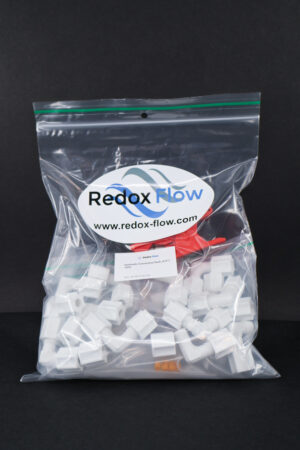
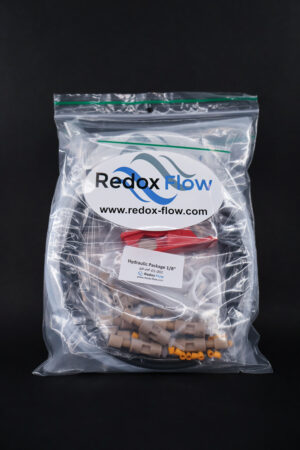
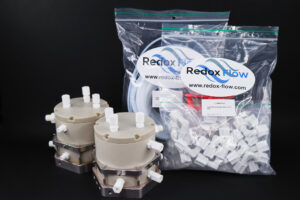
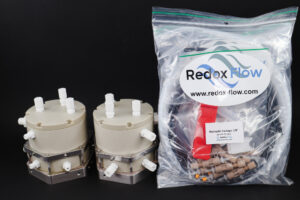
A functional electrolyzer R&D setup typically includes a flow cell, electrolyte reservoirs, a pump, temperature control, gas separation (for water-splitting experiments), and hydraulic connections. We offer all of these as individual components or as pre-configured packages. If you’re unsure which accessories you need, we can help scope a complete setup for your application.
Can you build a custom cell for my application?
Yes. Beyond our standard catalog, we routinely collaborate with researchers on custom active-area sizes, non-standard materials, novel flow-field geometries, and specialized multi-compartment architectures. For joint development with academic or industrial partners, contact us to discuss project scope.
What’s the operating temperature range?
M-Cell and X-Cell variants are rated to at least 90 °C.
Are these cells compatible with accessories from other manufacturers?
Our accessories use standard fittings (Swagelok 1/8″ or 1/4″ depending on model) and inert wetted surfaces, so they integrate easily with existing lab equipment. Our temperature control units in particular are designed as chemistry-agnostic inline heat exchangers that work with flow cells from any manufacturer.
Explore Related Product Categories