Gaskets for Electrolyzers
The Critical Role of Sealing in Electrochemical Cells
While often overlooked, gaskets are a critical component for the proper functioning and safety of any electrochemical cell. They prevent electrolyte leakage and gas crossover, define the cell’s active area, and hold the stack under the correct, uniform compression. The choice of gasket material and thickness is vital for optimal performance and long-term reliability of the electrolyzer.
Gasket Materials
- PTFE — maximum chemical resistance; compatible with aggressive acidic, alkaline, and organic electrolytes. Rigid, so ideal for precise spacing.
- Viton (FKM) — fluoroelastomer with good chemical resistance and compressibility. Ideal for sealing against membranes and flow bodies.
- EPDM — highly compressible with good resistance to alkaline electrolytes. Useful when high compressibility is needed to seal uneven surfaces.
How the Gasket System Works
Our modular design uses a combination of flow-field gaskets (which define the active area) and cover/spacer gaskets (which fine-tune total cavity thickness). This lets you precisely control electrode compression — typically 20–30% for carbon felts in electrolysis – for leak-free, reproducible assembly.
Gasket Products by Electrolyzer Cell Type
Gaskets for the X-Cell
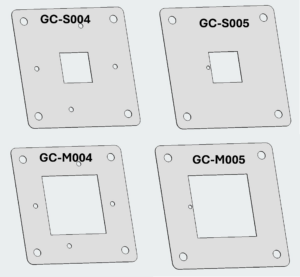
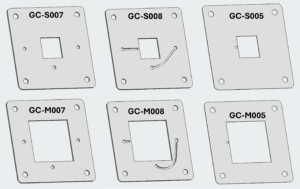
The standard gasket set for the X-Cell general electrolyzer, available for both current collector configurations. With flat current collectors (suited to thick electrodes >0.5–1.0 mm), both cover gaskets and flow-field gaskets are required. With flow-field current collectors (suited to thin electrodes <0.5–1.0 mm), cover gaskets alone are sufficient. Available in PTFE, Viton, and EPDM, from 0.05 mm to 2.0 mm, for 2.5×2.5 cm and 5.0×5.0 cm active areas.
Gaskets for the X-Cell with Reference Electrode — Flow Field Current Collectors
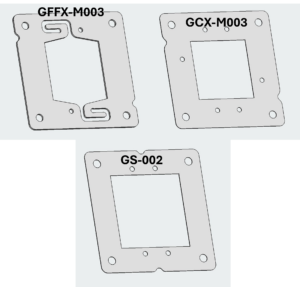
Cover gaskets for the X-Cell configured with reference electrode ports and flow-field current collectors. Three gasket types are required per assembly: Cover Gasket Type 1, a Central Gasket, and Cover Gasket Type 2. The final compressed electrode thickness equals the combined thickness of all cover/spacer gaskets. Available in PTFE, PTFE-reinforced, Viton, and EPDM, for 2.5×2.5 cm and 5.0×5.0 cm active areas.
Cover Gaskets for the X-Cell with Reference Electrode — Flat Current Collectors
Replacement cover gaskets for the X-Cell with reference electrode ports and flat current collectors. Both Type 1 and Type 2 cover gaskets are required and must be combined with the matching flow-field gaskets. Available in PTFE, PTFE-reinforced (PTFEG), Viton, and EPDM, with thicknesses from 0.05 mm to 1.0 mm, for 2.5×2.5 cm and 5.0×5.0 cm active areas.
Flow Field Gaskets for the X-Cell with Reference Electrode — Flat Current Collectors
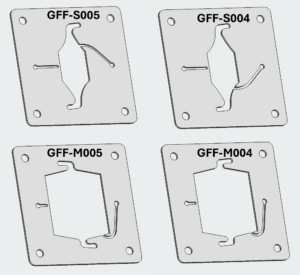
Replacement flow-field gaskets for the X-Cell with reference electrode ports and flat current collectors. The left and right gaskets are asymmetric and both are required; they must be combined with the matching cover gaskets. Available in PTFE, Viton, and EPDM, with thicknesses from 0.25 mm to 2.0 mm, for 2.5×2.5 cm and 5.0×5.0 cm active areas.
Gaskets for the X-Stack
Cover and flow-field gaskets for the X-Stack electrolysis cell, for use with flat bipolar plates and a 5×5 cm active area. The stack can be configured with up to 9 cells; each cell requires 4 cover gaskets and 2 flow-field gaskets per side. The combined thickness of the cover and flow-field gaskets on each side should match the desired compressed electrode thickness. Available in PTFE, PTFE-reinforced, Viton, and EPDM.
Porous Separator Sealing Gasket for the X-Cell
Required when using a porous separator in the X-Cell or X-Cell with reference electrode (not compatible with the X-Stack). In alkaline electrolysis, porous separators can leak through their edges; this gasket seals around the separator perimeter to prevent this. The open area is 6.0×6.0 cm and the gasket should be 0.05–0.2 mm thinner than the separator. Available in PTFE, Viton, and EPDM, from 0.1 mm to 1.0 mm, for both 2.5×2.5 cm and 5.0×5.0 cm active areas.
Porous Separator Sealing Gasket for the X-Stack
The X-Stack equivalent of the porous separator sealing gasket, featuring an integrated flow manifold matching the X-Stack’s internal channel layout. Prevents edge leakage through thick porous separators in alkaline electrolysis setups. The open area is 6.0×6.0 cm and the gasket should be 0.05–0.2 mm thinner than the separator. Available in PTFE, Viton, and EPDM, from 0.1 mm to 1.0 mm.
Custom Gaskets
For non-standard active areas, unusual electrode thicknesses, or custom flow-field geometries, we offer custom-cut gasket packages. Send us your cell dimensions and compression target, and we’ll prepare a configuration that matches.
FAQ
Which gasket material should I use?
For most electrolysis work, PTFE and Viton are the standard choices. PTFE for the most chemically aggressive environments or where precise spacing matters; Viton for the primary seal against membranes and flow bodies. EPDM is a good choice for alkaline-only setups where compressibility matters more than chemical breadth.
What thickness should I order?
It depends on your electrode thickness and desired compression. For a 1 mm carbon felt at 25% compression, you’d typically use a gasket stack totaling 0.75 mm. Our gasket packages include an assortment of thicknesses so you can dial in the exact compression for your experiment.
Can you make custom-shaped gaskets?
Yes. Send us your cell drawing or specifications, and we’ll quote a custom gasket package. We regularly cut gaskets for custom flow-field patterns, non-standard active areas, and multi-compartment configurations.
Explore Related Product Categories