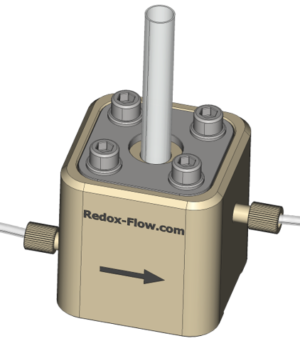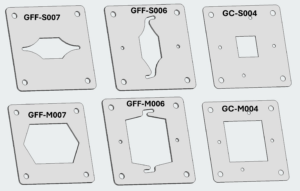
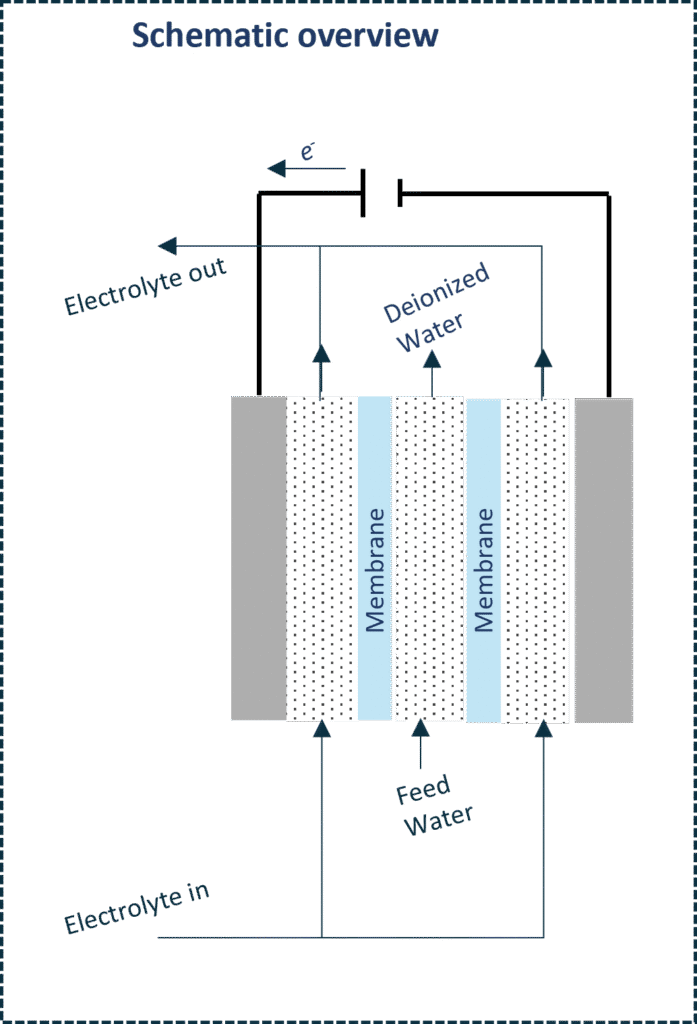
Our capacitive deionization product line supports cutting-edge research and development in electrochemical water treatment, desalination, and selective ion removal technologies. Our cells are designed as modular electrochemical flow cells and components tailored for research and development that allow you to test new electrode materials, ion-exchange membranes, spacer designs, or electrolyte compositions. Our systems are compatible with membrane CDI (MCDI) and flow-electrode CDI concepts.
Whether you’re investigating new capacitive materials or evaluating membrane selectivity, our platform provides the flexibility and reliability needed for advanced CDI research.
Capacitive deionization is an emerging, energy-efficient technology for water desalination and purification. A low-voltage electric field applied across a pair of porous carbon surfaces causes ions to be temporarily adsorbed via a process called electrosorption — effectively removing dissolved salts from the feed water. When the field is removed or reversed, the captured ions are released into a concentrated brine stream, regenerating the system for the next cycle. CDI is particularly attractive for brackish water desalination, where its energy consumption compares favorably to reverse osmosis at low-to-moderate salinities.
Our platform is designed to let researchers reconfigure between the major CDI architectures without swapping hardware: conventional CDI (bare porous electrodes), membrane CDI (MCDI — with ion-exchange membranes in front of each electrode to improve charge efficiency and salt removal), flow-electrode CDI concepts, and hybrid CDI systems that combine capacitive and Faradaic mechanisms. The same cell frame supports different electrode thicknesses, membrane placements, and spacer geometries.
Conventional CDI — bare porous carbon electrodes in direct contact with the feed stream. Standard configuration for fundamental electrode material characterisation and cell geometry studies.
Membrane CDI (MCDI) — ion-exchange membranes placed in front of each electrode improve charge efficiency and salt removal by preventing co-ion expulsion during desorption. Directly configurable on the same X-Cell frame.
Flow-electrode CDI (FCDI) — continuous-operation concepts using circulating capacitive slurries or multi-compartment designs. Our modular multi-compartment architecture and insert chamber system support FCDI configurations.
Hybrid CDI — systems combining capacitive and Faradaic charge storage mechanisms in the same cell. The X-Cell’s material-agnostic geometry accommodates custom electrode combinations.
The M-Cell and X-Cell platforms that power our CDI research cells also support electrolysis, CO₂ reduction, and electrodialysis — so the same hardware investment can serve multiple research directions, from CDI and MCDI to BMED and water splitting. A lab running both CDI and electrodialysis studies, for example, can use the same cell frame, gasket system, and accessories across both applications, with only the membrane and electrode configuration changing between experiments.

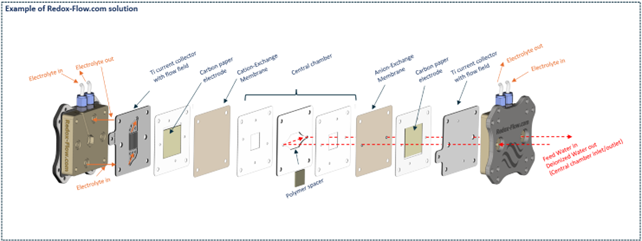
Configurable multi-compartment architectures, chemistry-agnostic wetted surfaces (PEEK/PTFE/EPDM), temperature-controlled operation, and full compatibility with commercial ion-exchange membranes and custom electrode materials — plus direct technical support from electrochemistry specialists.
We support custom CDI configurations and actively assist with project-specific requirements, including adaptation for non-standard electrode or membrane formats, prototyping of novel spacer and membrane stack configurations, consultation on flow distribution and compression, and integration of inline measurement systems. We welcome joint development partnerships with academic and industrial researchers working to advance electrochemical water treatment.
MCDI adds ion-exchange membranes in front of each porous electrode. The membranes block co-ions from leaving during desorption, which significantly improves charge efficiency and salt removal compared to membrane-less CDI, especially at higher salinities.
Yes. Our cells accept a wide range of electrode materials. The cell geometry is material-agnostic as long as thickness and form factor are compatible. Our modular gasket system covers a wide range of electrode thicknesses.
Our cells can be used for brackish water research, where CDI is most energy-competitive. Seawater-level salinities are possible for short-term studies but exceed CDI’s typical efficiency window.
Up to 95°C, depending on gasket and electrode material choices. The PEEK flow body is rated for this range; gasket material limits apply — PTFE, Viton, and EPDM all handle standard CDI operating temperatures comfortably.
1/8″ OD tubing is standard for single-cell CDI setups. 1/4″ is available for higher-flow configurations. Both are available with bottles or as bundled packages with a Multiport Electrolyte Reservoir pre-configured and ready to use.
Browse our portfolio of CDI flow cells, components, and accessories.
For custom configurations, project support, or bulk inquiries, feel free to get in touch.