
Whitepapers
Experimental studies run on Redox Flow hardware. Filter by application or topic, read online, or download the PDF.
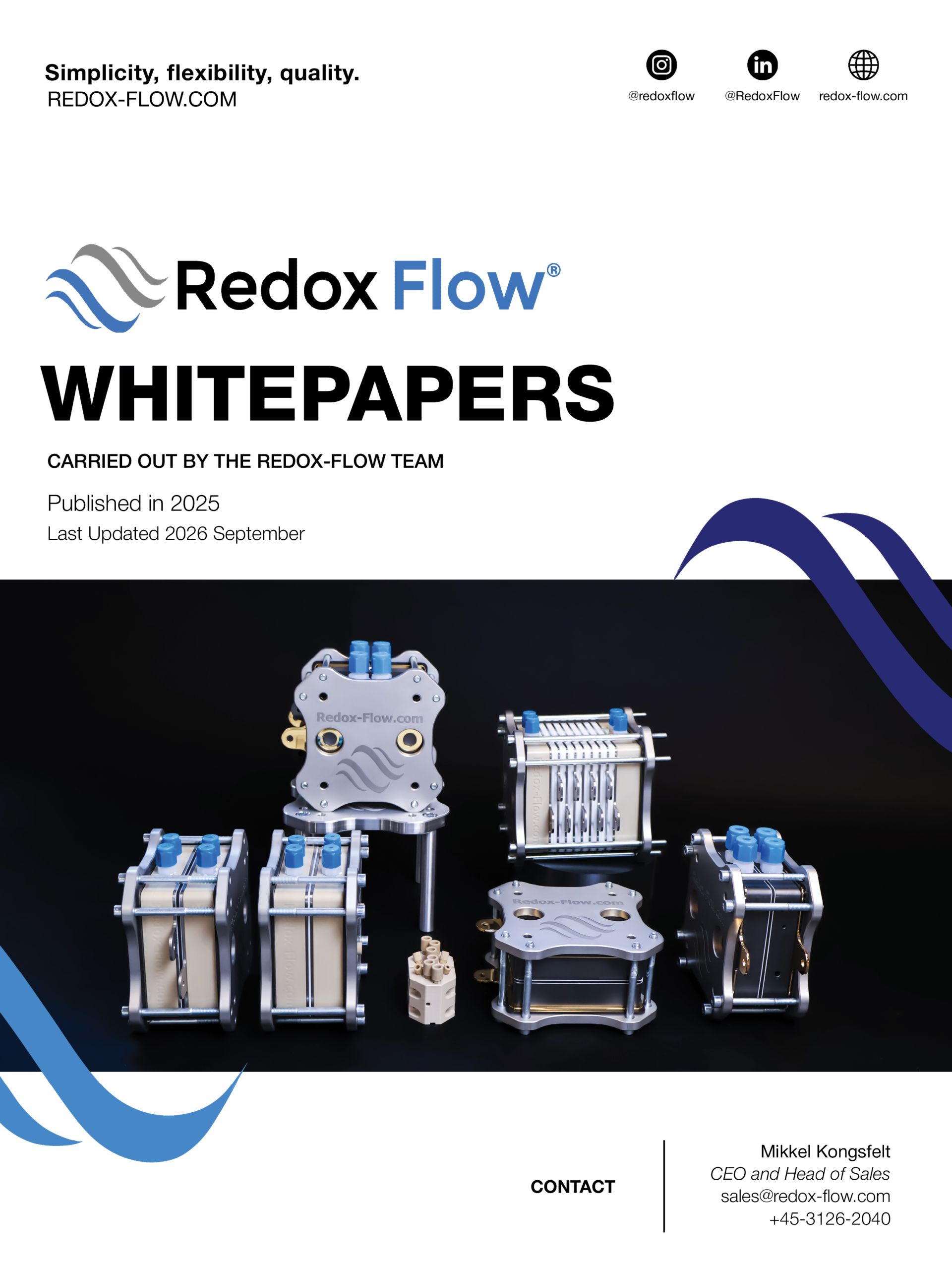
Whitepaper Booklet
Updated: March 26, 2026
White papers
Learn about each of our whitepapers.
No papers match these filters.
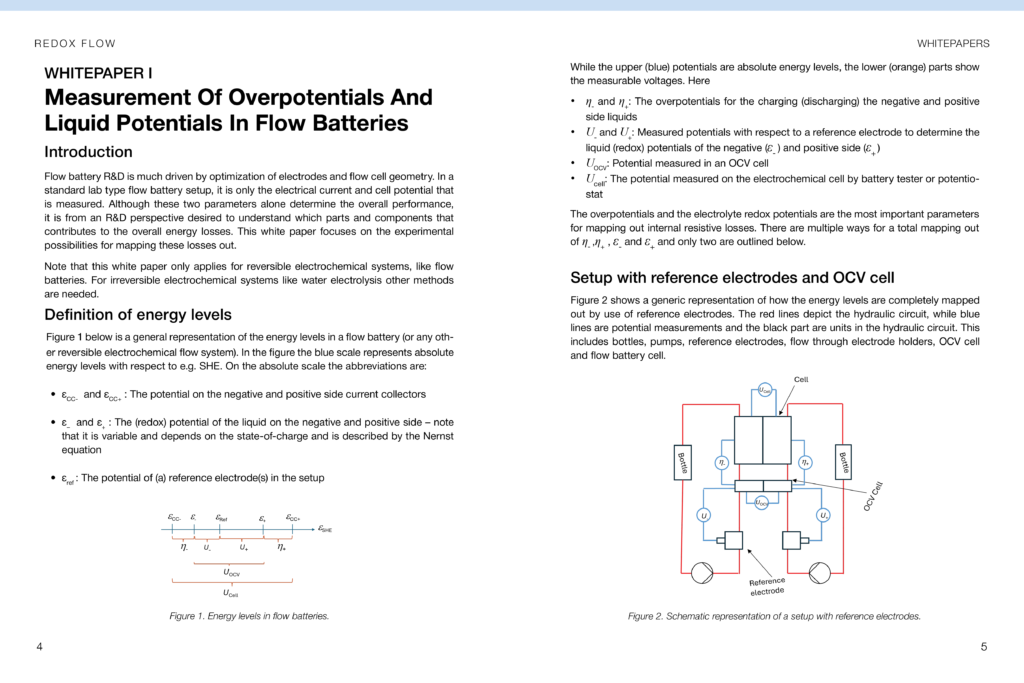
Flow battery R&D is much driven by optimisation of electrodes and flow cell geometry. In a standard lab type flow battery setup, it is only the electrical current and cell potential that is measured. Although these two parameters alone determine the overall performance, it is from an R&D perspective desired to understand which parts and components that contributes to the overall energy losses. This white paper focuses on the experimental possibilities for mapping these losses out.
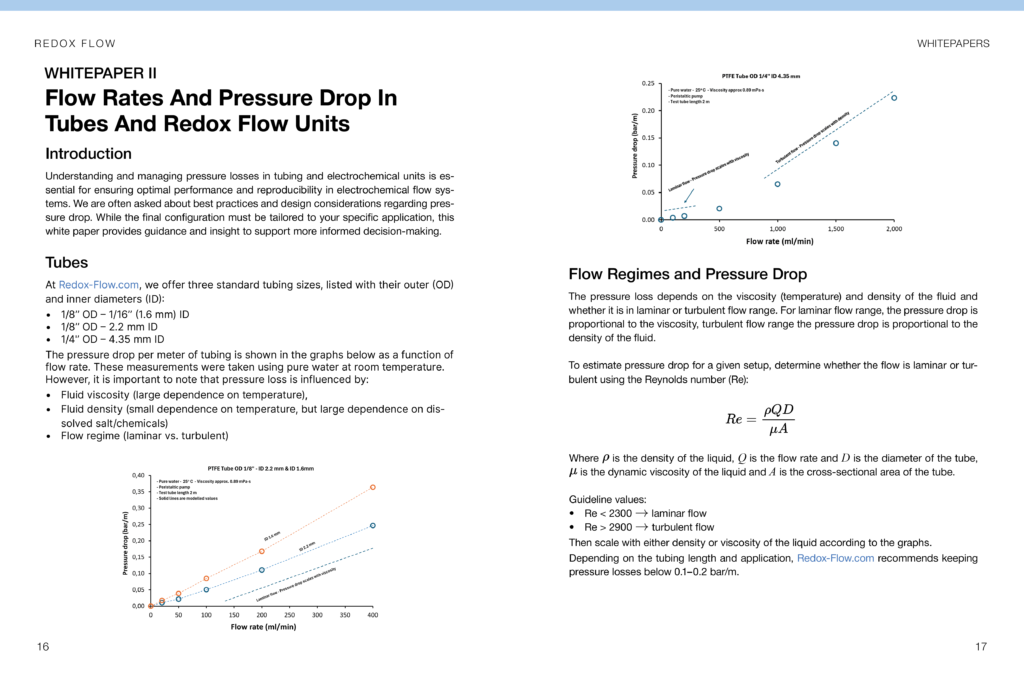
Understanding and managing pressure losses in tubing and electrochemical units is essential for ensuring optimal performance and reproducibility in electrochemical flow systems. We are often asked about best practices and design considerations regarding pressure drop. While the final configuration must be tailored to your specific application, this white paper provides guidance and insight to support more informed decision-making.
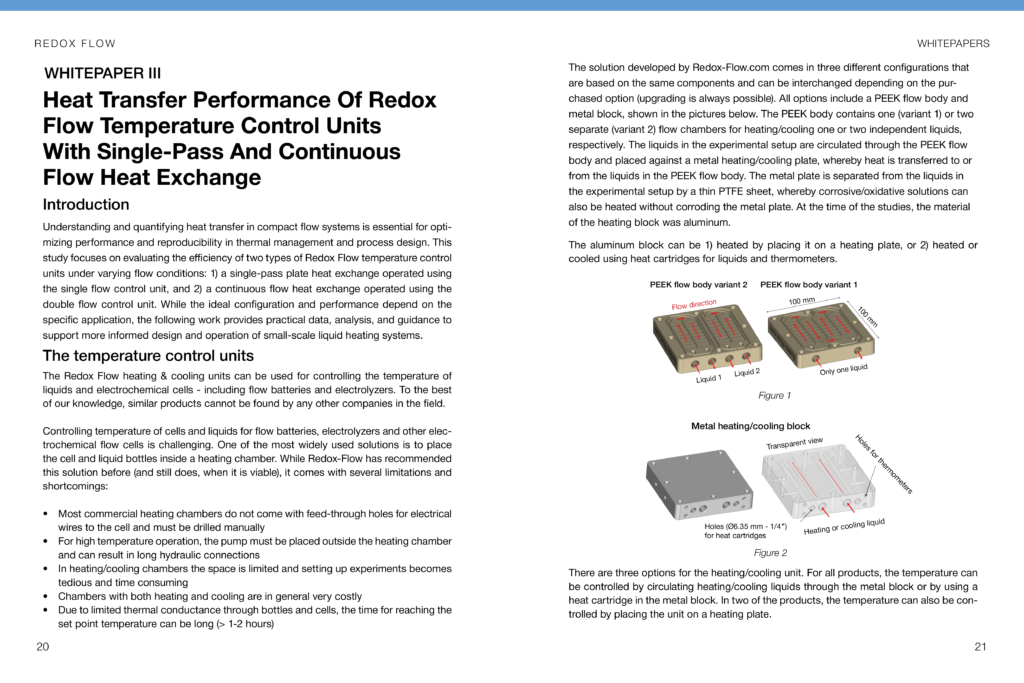
Understanding and quantifying heat transfer in compact flow systems is essential for optimizing performance and reproducibility in thermal management and process design. This study focuses on evaluating the efficiency of two types of Redox Flow temperature control units under varying flow conditions:
1) a single-pass plate heat-exchange operated using the single flow control unit, and
2) a continuous flow heat-exchange operated using the double flow control unit.
While the ideal configuration and performance depend on the specific application, the following work provides practical data, analysis, and guidance to support more informed design and operation of small-scale liquid heating systems.
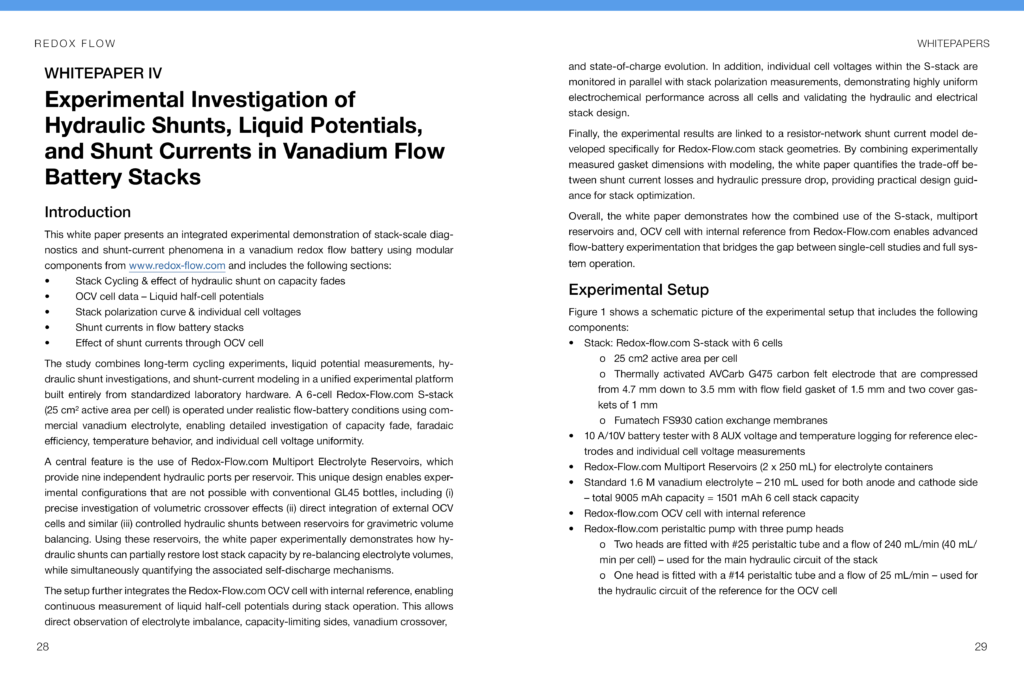
Experimental Investigation of Hydraulic Shunts, Liquid Potentials, and Shunt Currents in Vanadium Flow Battery Stacks
This white paper presents an integrated experimental demonstration of stack-scale diagnostics and shunt-current phenomena in a vanadium redox flow battery using modular components from Redox Flow.
The study combines long-term cycling experiments, liquid potential measurements, hydraulic shunt investigations, and shunt-current modeling in a unified experimental platform built entirely from standardized laboratory hardware. A 6-cell Redox-Flow.com S-stack (25 cm² active area per cell) is operated under realistic flow-battery conditions using commercial vanadium electrolyte, enabling detailed investigation of capacity fade, faradaic efficiency, temperature behavior, and individual cell voltage uniformity.
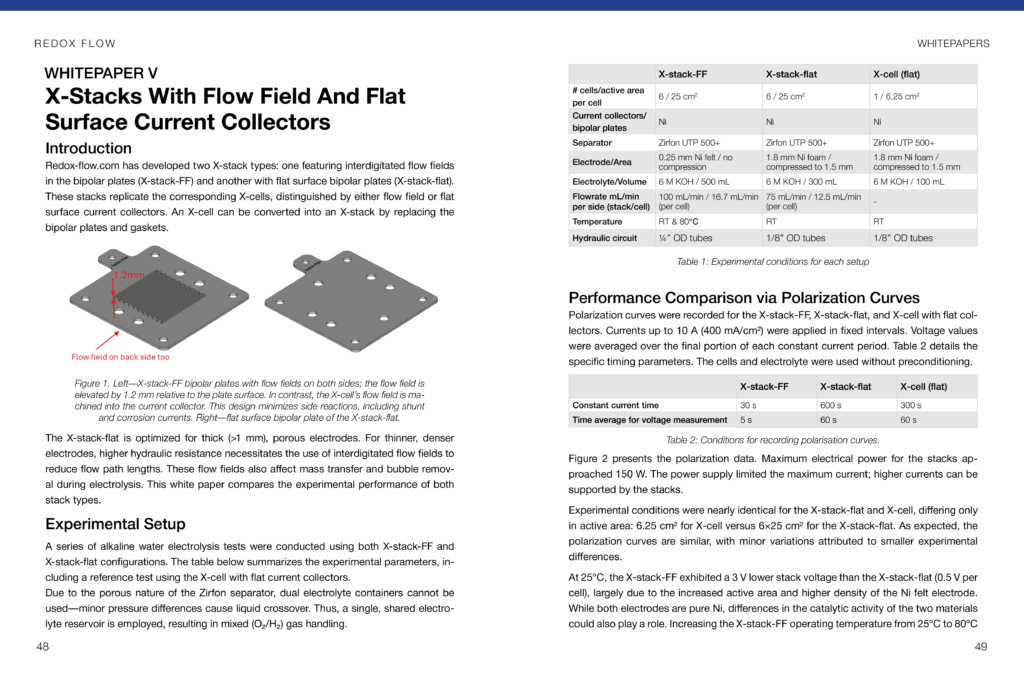
X-Stacks With Flow Field and Flat Surface Current Collectors
Redox-flow.com has developed two X-stack types: one featuring interdigitated flow fields in the bipolar plates (X-stack-FF) and another with flat surface bipolar plates (X-stack-flat). These stacks replicate the corresponding X-cells, distinguished by either flow field or flat surface current collectors. An X-cell can be converted into an X-stack by replacing the bipolar plates and gaskets.
The X-stack-flat is optimized for thick (>1 mm), porous electrodes. For thinner, denser electrodes, higher hydraulic resistance necessitates the use of interdigitated flow fields to reduce flow path lengths. These flow fields also affect mass transfer and bubble removal during electrolysis. This white paper compares the experimental performance of both stack types.
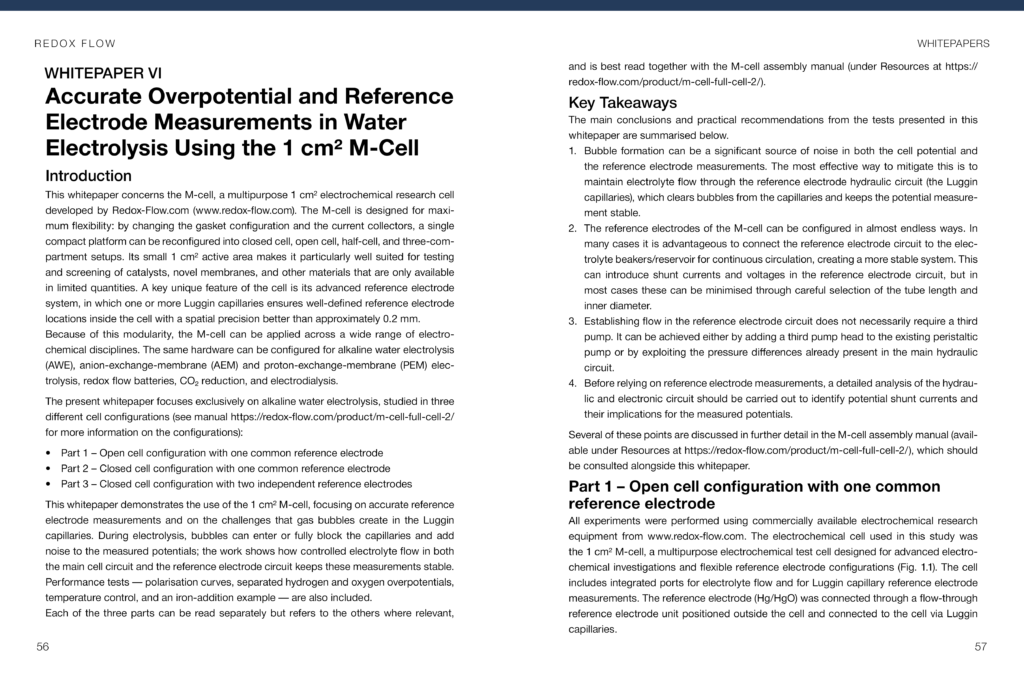
Accurate Overpotential and Reference Electrode Measurements in Water Electrolysis Using the 1 cm² M-Cell
This whitepaper concerns the M-cell, a multipurpose 1 cm² electrochemical research cell developed by Redox-Flow.com (www.redox-flow.com). The M-cell is designed for maximum flexibility: by changing the gasket configuration and the current collectors, a single compact platform can be reconfigured into closed cell, open cell, half-cell, and three-compartment setups. Its small 1 cm² active area makes it particularly well suited for testing and screening of catalysts, novel membranes, and other materials that are only available in limited quantities. A key unique feature of the cell is its advanced reference electrode system, in which one or more Luggin capillaries ensures well-defined reference electrode locations inside the cell with a spatial precision better than approximately 0.2 mm.
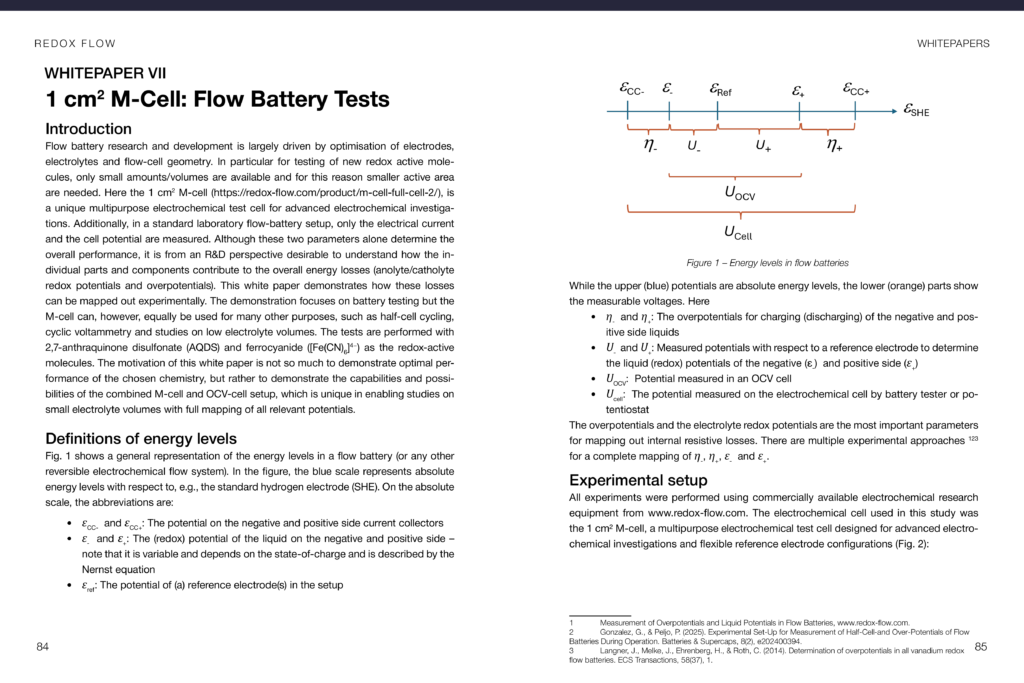
1 cm² M-Cell: Flow Battery Tests
Flow battery research and development is largely driven by optimisation of electrodes, electrolytes and flow-cell geometry. In particular for testing of new redox active molecules, only small amounts/volumes are available and for this reason smaller active area are needed. Here we use the 1 cm2 M-cell, is a unique multipurpose electrochemical test cell for advanced electrochemical investigations.. Additionally, in a standard laboratory flow-battery setup, only the electrical current and the cell potential are measured. Although these two parameters alone determine the overall performance, it is from an R&D perspective desirable to understand how the individual parts and components contribute to the overall energy losses (anolyte/catholyte redox potentials and overpotentials). This white paper demonstrates how these losses can be mapped out experimentally. The demonstration focuses on battery testing but the M-cell can, however, equally be used for many other purposes, such as half-cell cycling, cyclic voltammetry and studies on low electrolyte volumes.
Our research
Learn about our experiments using Redox Flow equipment
We would love to hear from you.
We receive a lot of questions regarding equipment specifications. Here you can find our whitepapers documenting some of our testing we have done, outlining the question, the setup, the results, and the answer.
Feel free to contact us if you have any questions, or interest!