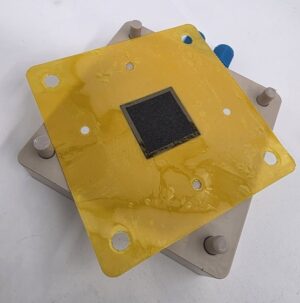
Sealing a CO₂ electrolyzer presents unique challenges, especially when operating with Gas Diffusion Electrodes (GDEs). A proper seal must be achieved without crushing the porous GDE structure. Our GDE Sealing Gasket Package has been specifically engineered to address these challenges, enabling a “zero-gap” cell configuration to reduce ohmic losses and allow for higher current densities.
Need help finding the right setup? Contact us for tailored guidance.
Product Categories
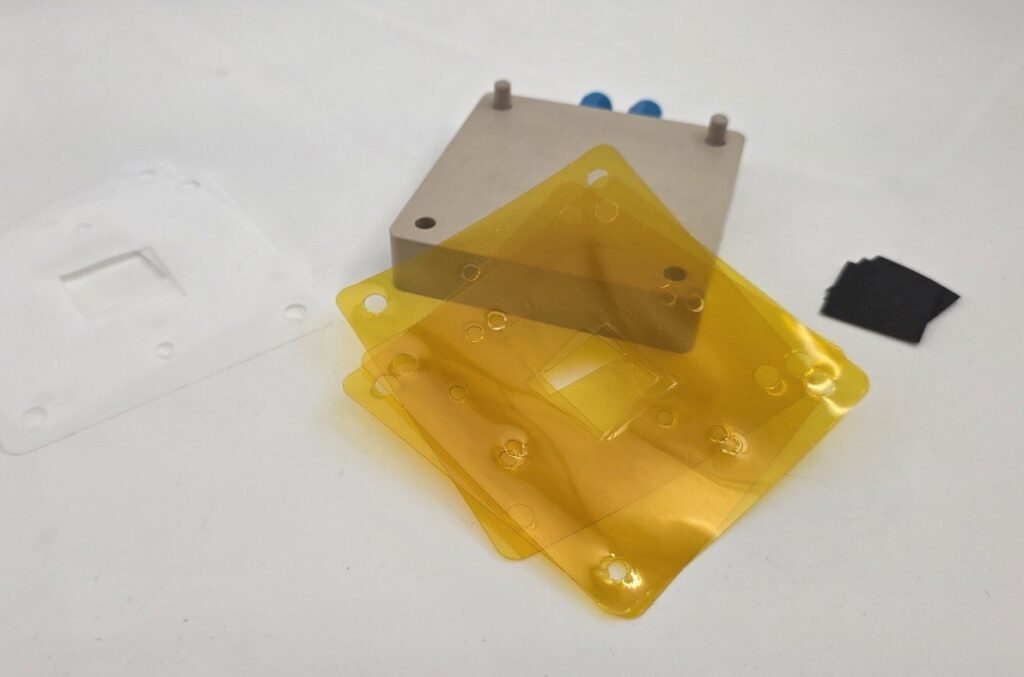
Sealing a CO₂ electrolysis cell with a gas diffusion electrode is not the same problem as sealing a standard electrochemical flow cell. The GDE is a porous, delicate, gas-permeable structure; the seal has to isolate the gas side from the liquid side without collapsing the gas-transport pathways that make the GDE work. Our GDE Sealing Gasket Package is purpose-built for this: a thin adhesive Kapton edge-seal bonds directly to the GDE perimeter, while a separate frame gasket (PTFE, Viton, or EPDM) sets the compartment thickness and carries the structural compression. The result is a tight gas/liquid seal with the GDE’s active area completely intact.
The GDE Sealing Gasket Package contains two complementary components that work together.
The Kapton edge-seal does double duty: it seals the GDE perimeter and precisely defines the exposed electrochemical active area. A 3×3 cm GDE paired with the 2.5×2.5 cm Kapton template yields exactly 6.25 cm² of exposed active area; a 6×6 cm GDE with the 5×5 cm template yields exactly 25 cm². This matters for CO₂RR kinetic studies where current density calculations, Faradaic efficiency, and catalyst loading per square centimetre need to be repeatable across experiments and across labs.
The GDE Sealing Gasket Package is designed for the Redox-Flow 3- and 4-compartment cell and for any setup that needs a gas-tight, liquid-tight GDE seal. Typical applications include:
These gaskets are used in combination with our modular CO₂ electrolysis cells. For the underlying hardware, see CO₂ Electrolysis Cells — in particular the X-Cell 3/4-compartment for the 2.5×2.5 cm and 5×5 cm formats described here, and the M-Cell Full Cell Configuration I for 1 cm² three-compartment CO₂RR work with standard electrodes.
GDEs are porous and gas-permeable; a standard gasket carries compression across the full face and crushes the gas-diffusion pathways. A GDE-specific package separates the two jobs: a thin Kapton edge-seal (63.5 µm) bonds and seals the GDE perimeter, while a separate frame gasket carries the compartment’s structural compression. The GDE’s active face stays open and functional. Designed for zero-gap setups.
The GDE Frame Gasket is supplied in 0.05, 0.1, 0.25, 0.5, 1.0, and 2.0 mm thicknesses, and frame gaskets can be stacked to match any GDE thickness. Only the gasket at the GDE’s liquid-side interface receives the Kapton seal, so stack height and sealing geometry stay independent.
3×3 cm and 6×6 cm. With the matching Kapton adhesive gasket, the exposed active area becomes exactly 2.5×2.5 cm (6.25 cm²) or 5×5 cm (25 cm²) — matching the flow-field dimensions of our X-Cell family.
PTFE for the widest chemical compatibility (full Ph range, halogens, aggressive anolytes/catholytes). Viton (FKM) for most CO₂RR service with good compression set and resilience. EPDM for alkaline-only service where low cost matters. All three are stocked in all six standard thicknesses.
Yes. Our GDE gasket package has been specifically designed for getting a proper seal without crushing the porous GDE structure – enabling zero-gap cell configurations, reducing ohmic losses and allowing for higher current densities.
The Kapton adhesive gasket ships in packs of 10 per flow-field size, so a single order supports multiple cell rebuilds. Frame gaskets ship in packs of 2 at each thickness/material combination — order extras if you’re running long campaigns or trialling multiple GDE thicknesses.
The Kapton adhesive gasket is single-use — once bonded to a GDE it cannot be cleanly removed and re-applied. The frame gaskets (PTFE, Viton, EPDM) can be reused across assemblies if undamaged.