
Our modular CDI flow cells provide a flexible and reliable platform for your research in water desalination and purification. Easily test various electrode materials and cell configurations to advance the field of electrosorption.
Need help finding the right setup? Contact us for tailored guidance.
Product Categories
Showing all 5 results
CDI Flow Cells, CO2 Electrolysis Cells, ...
From: 2,826.00 € Add to Quotation
CDI Flow Cells, CO2 Electrolysis Cells, ...
From: 3,320.00 € Add to Quotation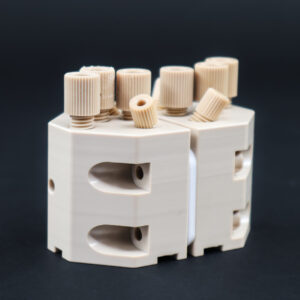
CDI Flow Cells, CO2 Electrolysis Cells, ...
From: 1,955.00 € Add to Quotation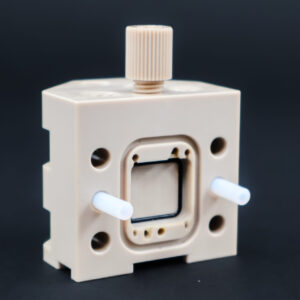
CDI Flow Cells, CO2 Electrolysis Cells, ...
From: 1,395.00 € Add to Quotation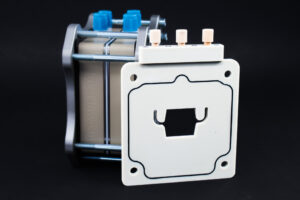
CDI Flow Cells, CO2 Electrolysis Accessories, ...
795.00 € Add to Quotation This product has multiple variants. The options may be chosen on the product pageIn capacitive deionization research, the flow cell is not just a housing for the electrodes — it defines the flow path geometry, the inter-electrode spacing, the compartment arrangement, and the accessibility of the electrode and membrane interfaces for reference measurements. A cell designed for reconfigurability lets you isolate the effect of each variable: electrode material, membrane type, compartment thickness, flow rate, and cell architecture can each be changed independently without replacing the cell hardware.
Our CDI cell range is built on the X-Cell platform, giving you a single hardware base that reconfigures between conventional CDI, membrane CDI (MCDI), multi-stream configurations, and three-electrode reference electrode studies — all on the same frame.
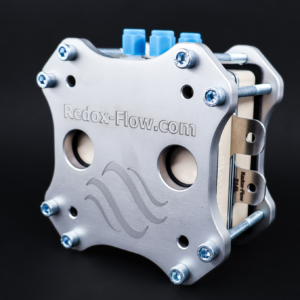
The X-Cell is the base platform for CDI research: a modular electrochemical flow cell with a PEEK flow body, interchangeable current collectors, and a configurable gasket system. In its standard 2-compartment configuration it serves as a conventional CDI cell — feed water flows through the inter-electrode gap while the porous carbon electrodes charge and discharge on either side.
The X-Cell accepts current collectors in nickel, titanium, stainless steel, copper, and other materials on request, with or without an integrated flow field, covering the full pH range and operating up to 95°C. Active area is switchable between 2.5×2.5 cm and 5×5 cm by changing gaskets and electrodes. For researchers characterising individual electrode materials in half-cell or full-cell mode, the standard X-Cell provides a well-defined, reproducible platform.
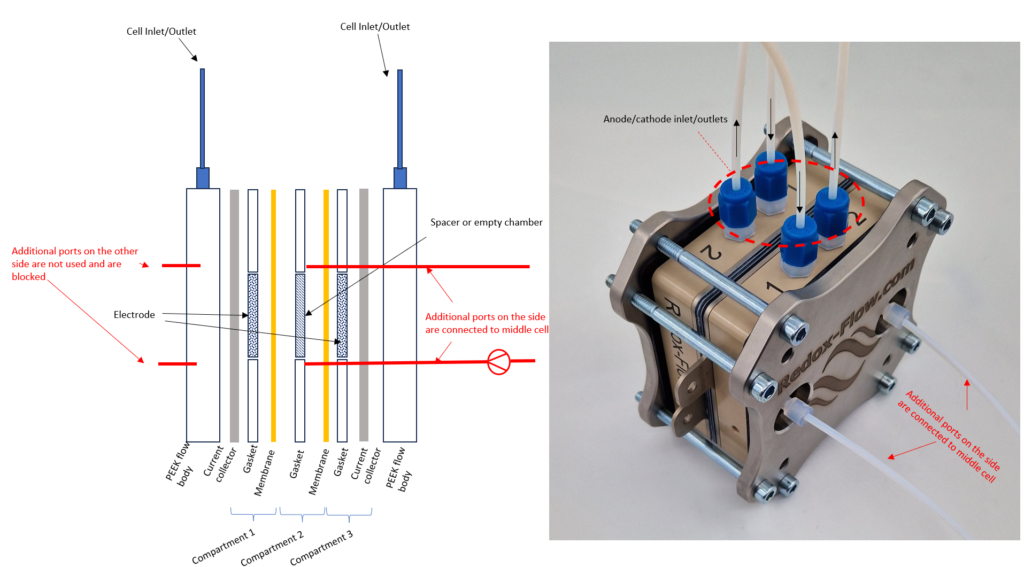
The 3/4-compartment X-Cell extends the standard platform with additional central compartments, enabling MCDI configurations and multi-stream electrodialytic setups. In a typical MCDI configuration, the central compartment carries the feed stream that is desalinated, while the two outer compartments serve as electrode rinse streams — ion-exchange membranes placed at each compartment boundary prevent co-ions from entering the feed stream, improving charge efficiency and salt removal performance compared to membrane-less CDI.
The same hardware accommodates 3-compartment (one feed stream) and 4-compartment (two feed streams separated by a middle membrane) configurations. Active areas of 2.5×2.5 cm and 5×5 cm are both supported, and all compartments use the same modular gasket system as the standard X-Cell, so compartment thickness and electrode compression are independently configurable.
The M-Cell is a compact 1 cm² multipurpose research platform that extends the CDI cell range to very small active areas. For CDI research, its primary role is fundamental electrode material screening — the 1 cm² active area significantly reduces material requirements when evaluating expensive, novel, or limited-quantity capacitive electrode materials where a 2.5×2.5 cm or 5×5 cm test would consume too much sample.
In its closed two-compartment configuration (Configuration A), the M-Cell operates as a standard full CDI cell. In its half-cell configurations (G-1, G-2), it isolates a single working electrode with a precisely positioned reference electrode — enabling clean three-electrode CV measurements, chronoamperometry, and capacitance characterisation of individual CDI electrode materials under defined flow-through mass transport conditions. The Luggin capillary reference electrode system places the measurement point within approximately 0.2 mm of the electrode surface, giving electrochemical data directly comparable to a rotating disk electrode setup but applicable to porous electrode geometries where RDE measurements are not feasible.
The Insert Chamber is a polypropylene accessory that converts any standard X-Cell into a 3-, 4-, or more-compartment configuration by inserting between existing cell components. In addition to adding a flow-through compartment with its own inlet and outlet ports, it includes a reference electrode port accepting thin reference electrodes with diameters of 0.8–1.6 mm — enabling local potential measurements inside the CDI stack without modifying the main cell body.
The standard insert thickness is 3 mm, expandable with gaskets or available in custom dimensions on request. For CDI research, the Insert Chamber is particularly useful for adding a reference stream to an existing 2-compartment cell, studying local potential distribution in multi-compartment MCDI configurations, and integrating reference electrodes for three-electrode measurements alongside full-cell cycling. Compatible with 2.5×2.5 cm and 5×5 cm active areas.
For fundamental electrode characterisation (CDI): Start with the standard X-Cell in 2-compartment mode. It gives clean, well-controlled access to electrode kinetics and capacitance with minimal geometric complexity.
For MCDI research: Use the 3/4-compartment X-Cell. The central compartment carries the feed stream and the outer compartments carry the electrode rinse, with membrane placement at the compartment interfaces. This matches the standard MCDI architecture used in the literature.
For reference electrode measurements or adding a stream to an existing setup: The Insert Chamber is the fastest route — it adds a compartment and a reference electrode port to any existing X-Cell without purchasing a new cell.
For electrode material screening at minimal sample consumption (CDI): The M-Cell Full Cell or Half Cell at 1 cm² is the right starting point. The small active area reduces electrode material requirements by more than an order of magnitude compared to the standard X-Cell, and the Luggin capillary reference system enables accurate three-electrode characterisation alongside full-cell cycling data.
For fundamental studies of electrode materials — salt adsorption capacity, charge efficiency, cycling stability — the standard X-Cell in 2-compartment mode is the right starting point. It minimises geometric complexity while giving reproducible, well-defined flow conditions. Move to the 3/4-compartment configuration when you want to evaluate MCDI or study multi-stream operation.
In the standard X-Cell (2 compartments), the feed water flows directly between the two porous electrodes — this is conventional CDI. In the 3/4-compartment cell, ion-exchange membranes are placed between the central feed compartment and the outer electrode compartments. The membranes prevent co-ions from leaving the electrode chambers during adsorption, which increases charge efficiency and improves salt removal. The cell hardware is the same; only the compartment count and membrane placement change.
Yes. The X-Cell accepts any electrode material compatible with the active area dimensions (2.5×2.5 cm or 5×5 cm) and the compressed thickness range set by the gasket system. The flow body, current collectors, and gaskets are all material-agnostic. Contact us if your electrode is non-standard in thickness or format.
Yes, in two ways. The Insert Chamber provides a dedicated reference electrode port (Ø0.8–1.6 mm) for inserting thin reference electrodes into the flow path between compartments. For cells requiring external reference measurement, the Flow-Through Electrode Holder (from our CDI accessories range) installs inline in the effluent tubing for continuous potential or conductivity monitoring.
Up to 95°C, depending on gasket and current collector material. PEEK flow bodies handle this range. Most CDI research runs at ambient temperature, but elevated temperature operation is supported for studies of temperature effects on adsorption kinetics or electrolyte conductivity.
Yes. The X-Cell accepts standard membrane sheet sizes and the gasket system controls compression independently of membrane thickness. We also supply Fumatech ion exchange membranes pre-cut to fit our cell active areas. See our full membrane selection for options compatible with CDI and MCDI research.