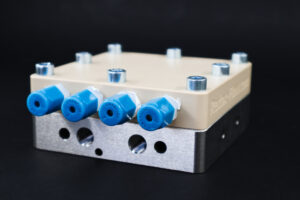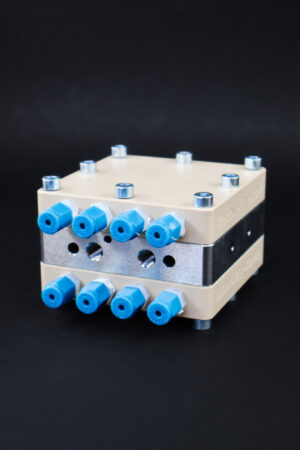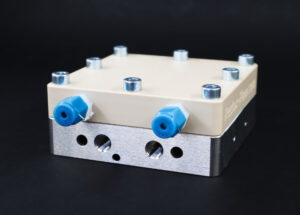
Achieve precise, stable thermal management for your electrochemical experiments — without the bulky heating chamber. Our compact inline heat exchangers transfer heat directly to the electrolyte for flow batteries, electrolyzers, CO₂ electrolysis, electrodialysis, and other flow-cell research. Three configurations (Single Flow, Double Flow, High Power), one modular platform.
Need help finding the right setup? Contact us for tailored guidance.

Product Categories
Showing all 3 results
Temperature is a critical parameter in electrochemical research, directly influencing reaction kinetics, material stability, and overall system efficiency. Maintaining a stable and precise operating temperature is essential for reproducible, accurate results. Our Temperature Control Units are engineered to deliver responsive, uniform heating and cooling directly to your cell and electrolyte — overcoming the limitations of conventional heating chambers.
A heating chamber is the default answer — and we still recommend it for some applications. But for most lab-scale electrochemistry, chambers introduce practical headaches:
Our inline heat exchangers solve all five. A 500 mL volume reaches 75 °C in about 15 minutes and stabilizes within 35–45 minutes, and the unit fits on any benchtop or inside a fume hood.
Every unit is built from two parts: a PEEK flow body and a stainless steel block, separated by a thin PTFE sheet.
Net effect: stainless steel gives you the thermal conductivity you need for responsive control, and PEEK + PTFE keep your electrochemistry clean. No metal touches your fluid path.
Every unit supports multiple control strategies so you can match your existing lab infrastructure:
The simplest configuration. Set the stainless steel block on a PID-controlled hot plate and the liquid temperature follows. Ideal for labs already equipped with a standard hot plate. (Available on the Single Flow and Double Flow units.)
Four ⅛” BSPP threaded ports on the steel block accept heating or cooling water from an external circulator. Use for sub-ambient cooling, precise PID control from an external chiller, or when a hot plate isn’t practical.
Two through-holes accept 1 to 4 standard heat cartridges (sold separately). Useful for compact setups or when a hot plate is unavailable.
One PEEK flow body with a single heating channel. Ideal for alkaline water electrolysis with a shared electrolyte, or any application using a single circulating stream. Can be placed on a hot plate, heated with cartridges, or run from circulating fluid.
One PEEK flow body with two independent channels — heat or cool anolyte and catholyte simultaneously from the same unit. The natural choice for most flow-cell work where two separate electrolyte streams are circulated, including flow batteries, PEM/AEM/alkaline electrolysis, and CO₂ electrolysis. Supports hot plate, cartridge, and circulating fluid control.
Two PEEK flow bodies sandwich a stainless steel block. Run two independent streams, or couple them in parallel for higher heating/cooling power on a single stream. Recommended for stacks and any application where higher thermal power is needed. Cartridge and circulating fluid control; not designed for hot plate operation.
Only PEEK, PTFE, and polymer fittings contact your electrolyte. The PTFE sheet between the stainless steel block and the flow body prevents any metal-electrolyte contact, so aggressive acidic, alkaline, and organic chemistries run without contamination, corrosion, or degradation of the unit.
Because the unit is an inline heat exchanger with inert wetted surfaces, it integrates into many electrochemical flow loops. Whether you’re running a Redox-Flow X-Cell, M-Cell, S-Cell, A-Cell, or a third-party electrolyzer, the unit integrates into existing flow loops via standard Swagelok fittings.
All three units are built from the same core components and share the same form factor. Start with the configuration that matches your current project — you can upgrade or reconfigure later without replacing your whole setup.
The same lab-scale electrolyzer thermostat supports PEM electrolyzer temperature control, AEM electrolyzer temperature control, alkaline electrolyzer temperature control, CO₂ electrolyzer temperature control, and flow battery temperature control. One unit, every chemistry you’re likely to run at the bench.
Each electrolyzer cooling unit also acts as a heating unit, giving you responsive control across your full operating range. Run temperature-dependent studies, characterize thermal stability, or simply hold a cell at its optimal setpoint — all from the same piece of equipment.
Pick Single Flow if you circulate one shared electrolyte (for example, some alkaline water electrolysis setups). Pick Double Flow if you run two independent streams — the most common case for flow batteries, PEM/AEM/alkaline electrolysis, CO₂ electrolysis, and electrodialysis. Pick High Power for stacks or applications that require higher heating/cooling power than the Single or Double units can deliver.
Yes. The units are chemistry-agnostic inline heat exchangers with PEEK and PTFE wetted surfaces, and use standard Swagelok ⅛” fittings. They integrate into any existing electrochemical flow loop as a drop-in retrofit.
In a 500 mL water volume on a 600 W PID-controlled hot plate, our test runs reach 75 °C within about 15 minutes and stabilize within 35–45 minutes. More aggressive control strategies that allow temperature overshoot can shorten this further.
Yes. The wetted surfaces are inert (PEEK and PTFE), so the same unit handles alkaline water electrolysis (AWE), PEM, AEM, CO₂ electrolysis (CO₂RR), electrodialysis, and flow battery electrolytes. Not intended for high-temperature gas-phase systems such as SOEC.
Yes. Each unit functions as both a heater and a cooler — hot plate and cartridge operation deliver heating; circulating a chilled fluid through the steel block delivers cooling. The combination covers the full lab-scale operating range.
No. Heat cartridges are sold separately. The unit ships with mounting holes for 1 to 4 cartridges and screw mounts to prevent cartridge movement during operation.
Swagelok ⅛” OD fittings are standard for the electrolyte side; ⅛” BSPP threads on the steel block accept heating/cooling water connections. Other diameters available on request.
A heating chamber warms the air around your cell, which is slow to respond and uneven across the cell surface. Our inline heat exchanger heats or cools the electrolyte directly, giving you faster response, more uniform temperature across the active area, and a much smaller bench footprint. For most lab-scale electrochemical experiments, this is a more precise and space-efficient approach.