
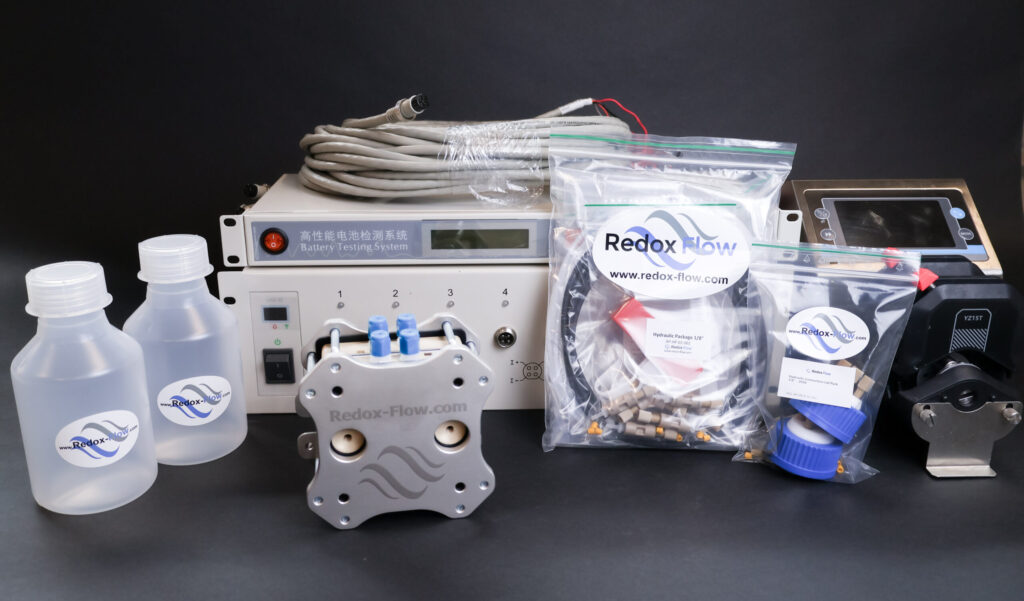
We can provide full setups, that get your started with your development immediately. Setups for flow-battery research, alkaline electrolysis, PEM electrolysis, and much more. Setups ship with the cell, dual-channel pump, fluid handling package, and primary instrumentation, pre-selected and matched for immediate use.
Reach out to us to learn more about adapting our setups for your specific application.
Product Categories
Sourcing, qualifying, and assembling an electrochemical test station from individual components is a significant undertaking. Each component needs to be compatible with your target chemistry, your cell geometry, and every other part of the circuit — and even a well-specified list of parts can take weeks to arrive, commission, and validate. Our complete setups remove that process entirely.
Both setups on this page have been configured as fully integrated systems: the cell, the fluid handling, the pump, and the primary instrumentation all arrive together, matched to work as a unit. The result is a research-grade test station that is ready for experiments within hours of receipt, not weeks.
The electrolysis setup is built around the X-Cell, our modular general-purpose electrolyser. Its defining advantage is an interchangeable current collector system: collectors in titanium, nickel, stainless steel, platinum-coated titanium, gold-coated titanium, and copper — with or without an integrated flow field — can be swapped without replacing the cell body, letting you reconfigure the same station for alkaline water electrolysis, AEM electrolysis, PEM electrolysis, CO₂ reduction, or other electrochemical processes as your research evolves. The active electrode area switches between 2.5×2.5 cm and 5×5 cm by exchanging gaskets and electrodes. The PEEK flow body handles the full pH range and media up to 30 wt% KOH, with operation up to 90°C and pressures up to 10 bar. Alternatively, PTFE flow bodies are also available, if that fits your chemistry better.
The standard package includes the configured X-Cell, a 1/8″ hydraulic connection package (PTFE hard tubing, Norprene peristaltic tubing, compression fittings, 4-port reservoir lids, and bottles in Pyrex glass or polypropylene), an optional H₂/O₂ gas separation unit, a dual-channel BT600L peristaltic pump, and a choice of programmable DC power supply — the BK Precision 9182B for single-cell work (0–10 V / 20 A or 10–20 V / 10 A, LAN control) or the XLN3640 for stack-level testing (36 V / 40 A, 1.44 kW, USB and RS485 with optional GPIB and LAN). Membranes and electrodes are not included, as the correct choices depend on your specific process.
The flow battery setup is designed for charge–discharge cycling and electrochemical characterisation of redox flow battery chemistries. The cell selection at the heart of the setup determines electrode thickness range: the A-Cell uses an interdigitated flow field and is optimised for thinner electrodes (up to approximately 0.5–1.0 mm), while the S-Cell has a flat surface and suits thicker electrodes (above approximately 1.5 mm). Both cells operate with a 2.5×2.5 cm active area, cover the full pH range, and use corrosion-resistant graphite flow bodies with gold-plated copper current collectors. The A-Cell has been in commercial use for nearly a decade and is deployed across more than 100 research groups and companies worldwide.
The package includes the chosen flow battery cell, a dual-channel BT600L peristaltic pump, the 1/8″ hydraulic connection package, and an 8-channel battery tester with software and electrical connections. The battery tester operates across a 0–5 V range with selectable current options (from 20 mA up to 12 A per channel), records data at up to 10 Hz with ±0.05% accuracy, and requires the separate Control Unit (included) to connect with a PC. A single Control Unit can manage up to 32 battery testers in parallel. The tester can also be used as a programmable power source for electrolyser experiments where only the charge function is needed.
An optional AUX Unit adds 8 auxiliary voltage measurement channels (0–5 V, 5 mV resolution) and 8 thermocouple temperature measurement channels (0.1°C resolution) to the battery tester, with data recorded in a single file alongside the main cycling data. The unit ships with 8 thermocouples and 8 crocodile cables. Electrodes, membranes, and electrolytes are not included.
Both setups draw on the same fluid handling and pumping platform, which means the hydraulic connection package and BT600L peristaltic pump are compatible with either station. This is useful if you are running both electrolysis and flow battery experiments in the same lab — shared spare parts, shared tubing specifications, and shared pump operation simplify maintenance and reduce inventory.
The 1/8″ hydraulic package supports four standard circuit configurations: two-channel two-bottle (standard for flow batteries and electrolysers), two-channel single-bottle (electrolysers), two-channel single-bottle with gas separation, and one-channel single-bottle with gas separation. The gas separation unit is sold separately and is relevant primarily for electrolysis setups where hydrogen and oxygen are produced.
Important safety note: In electrolysis setups producing H₂ and O₂, gas crossover through membranes or separators means the headspace of shared reservoirs can accumulate mixed gas over time. Keep reservoir headspace minimal, ensure active ventilation from bottles and gas separation units, and never operate in an unventilated enclosure. Always conduct an independent safety assessment in accordance with your facility guidelines and applicable ATEX regulations.
Both setups are designed with the reality of laboratory research in mind: protocols change, chemistries evolve, and the same piece of hardware needs to serve multiple purposes over its lifetime.
The electrolyser setup reflects this through the X-Cell’s interchangeable current collector system, which lets you reconfigure the same station for a different electrolysis chemistry — alkaline to AEM to PEM, for example — without replacing the cell body or rebuilding your fluidics. The flow battery setup reflects it through the battery tester’s 8 independent channels, which allow parallel testing of different conditions, membrane types, or electrolyte compositions in a single instrument.
In both cases, every component in the package is available individually. If your research expands — more cells, additional measurement channels, a temperature control loop, inline spectroscopy — you add exactly what you need without replacing the infrastructure already in place.
Both setups include provisions for direct temperature measurement at the cell, though the implementations differ between platforms.
The X-Cell electrolyser features an integrated sensor block: a precision-machined aluminium insert embedded in the PEEK flow body and in direct contact with the current collector, giving accurate in-situ temperature readings with minimal thermal lag. It accepts standard thermometer and thermocouple probes in 3 mm, 4 mm, and 1/8″ formats.
The A-Cell and S-Cell flow battery cells take a simpler approach: each side of the graphite flow body has dedicated ø2 mm and ø4 mm probe ports, allowing direct insertion of a thermometer or thermocouple into the cell body adjacent to the electrode compartment.
For active temperature control — as opposed to monitoring only — both setups are compatible with our dedicated temperature control system, which regulates electrolyte temperature through an inline flow heat exchanger. See our Temperature Control Solution.
The X-Cell’s interchangeable current collector system and broad chemical compatibility make the electrolysis station suitable for a wide range of electrochemical research beyond standard water splitting:
The A-Cell and S-Cell, combined with the 8-channel battery tester, are designed for systematic charge–discharge cycling and electrochemical characterisation of flow battery chemistries:
While we offer standardized packages, every research project is unique. Our complete setups are highly modular — if you’re working with specialized aggressive electrolytes, require specific flow rates, or need to integrate custom inline sensors, we can tailor the setup to your exact specifications. Reach out to us to discuss your application, and we’ll configure a setup that lets you focus on your research, not on building equipment.
Both setups exclude electrodes, membranes, and electrolytes. These are application-specific: the right electrode and membrane for vanadium chemistry differs significantly from what you’d use for alkaline water electrolysis or CO₂ reduction. We stock a full range of both — see our membranes and electrodes categories.
Yes. Both setups are based on modular platforms. The electrolyser setup can be extended with additional current collectors for different chemistries, a temperature control unit, inline pressure monitoring, reference electrode ports, a UV/Vis fibre-optic flow cell, and more. The flow battery setup can be extended with the AUX Unit for temperature and auxiliary voltage logging, or additional battery tester units for parallel cell testing.
All components within both setups are available individually. If you already own a pump, a power supply, or a set of reservoirs, contact us with a description of your existing equipment and we’ll quote only the components you need, with compatibility confirmed.
Lead time depends on configuration and current stock of individual components. Contact us with your target specification for a current delivery estimate.
Yes. We can configure packages including a Zahner potentiostat for impedance spectroscopy and three-electrode measurements. Contact us to discuss your specific measurement requirements.

