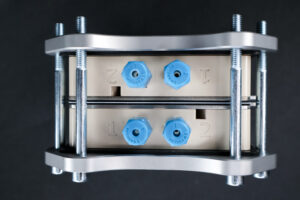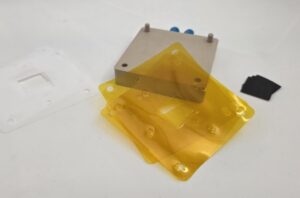
Accelerate your research in carbon capture and utilization (CCU) with our advanced CO₂ electrolysis equipment. We provide research-grade electrochemical flow cells, GDE sealing gaskets, AEMs, accessories, and components designed for the electrochemical CO2 reduction reaction (CO₂RR). Explore our M-Cell and X-Cell product lines for CO₂RR research, our GDE sealing gasket packages, our fumasep FAA-3 membrane family, and the full supporting infrastructure.
Need help finding the right setup? Contact us for tailored guidance.
Product Categories
The electrochemical CO₂ reduction reaction (CO₂RR) is a transformative pathway for converting captured carbon dioxide into valuable fuels and chemical feedstocks — including carbon monoxide (for syngas), formic acid, ethylene, ethanol, and other multi-carbon products. CO2 reduction is a critical piece of a future circular carbon economy, offering a way to store renewable energy in chemical bonds and mitigate greenhouse gas emissions.
Our CO₂ electrolysis portfolio is built around the demanding requirements of CO₂RR research: gas diffusion electrode (GDE) compatibility, multi-compartment architectures, controlled compression, inert-gas-compatible electrolyte handling, and the ability to test diverse catalyst and membrane materials on a single reconfigurable platform.
Our flow-cell systems support CO2 reduction research across the full product landscape:
The X-Cell platform that supports CO₂RR research can be reconfigured for alkaline water electrolysis, AEM electrolysis, or electrodialysis simply by swapping gaskets, electrodes, and membranes. The M-Cell extends this flexibility to the 1 cm² scale, where ten distinct operating configurations — closed cell, open cell, half-cell, and three-compartment — are supported on the same hardware. This shared platform means your CO₂ electrolysis setup doubles as a general-purpose electrochemistry bench.
We support custom designs and are happy to assist with project-specific requirements, including:
Whether you’re screening catalysts, characterising membranes, or building a full CO₂RR prototype, our team can help scope the right combination of hardware for your project.
Yes. Our GDE sealing gasket packages are specifically engineered to seal against porous GDEs without crushing them, enabling zero-gap cell configurations that reduce ohmic losses and allow higher current densities.
Any catalyst you can deposit onto a GDE or porous substrate — copper-based catalysts for multi-carbon products, silver for CO, bismuth or tin for formate, and so on. The platform is catalyst-agnostic.
Yes. The M-Cell supports CO₂RR in closed-cell, open-cell, and three-compartment configurations, and its half-cell mode is well-suited for cathode-side CO2 reduction studies where a precisely placed reference electrode is required. Its 1 cm² active area is ideal for screening novel catalysts where sample quantity is limited.
Yes. Both the X-Cell (with 3 or 4 chambers) and the M-Cell (Configuration I) support three-compartment operation, which is useful for separating anolyte, catholyte, and a central compartment — enabling bipolar-membrane studies, buffered-electrolyte concepts, and integrated capture-and-reduction architectures.
Yes. The X-Cell and M-Cell platforms are reconfigurable between chemistries by swapping gaskets, electrodes, and membranes. Many labs use a single cell for both CO₂RR and water-splitting research.
Our CO₂ electrolysis cells are rated to at least 90 °C, limited by the PEEK flow bodies and elastomer gaskets. This covers the full range of liquid-phase CO₂RR research. For high-temperature gas-phase electrolysis such as SOEC (solid oxide electrolysis of CO2, typically 600–900 °C), our cells are not suitable — that regime requires ceramic architecture rather than polymer-based flow cells.
Yes. Send us a description of your target product, preferred catalyst and membrane, and any constraints (active area, flow rate, temperature, inert-gas requirements), and we’ll propose a complete configuration — cell, gaskets, membranes, reservoir, connections, and optional temperature control and reference instrumentation.