
Equip your CO₂ electrolysis research platform with our essential accessories. We offer multiport reservoirs for advanced electrolyte management, cell assembly stands for uniform compression, and a range of hydraulic components to complete your experimental setup.
Need help finding the right setup? Contact us for tailored guidance.
Product Categories
Showing all 9 results
CDI accessories, CO2 Electrolysis Accessories, ...
495.00 € Add to Quotation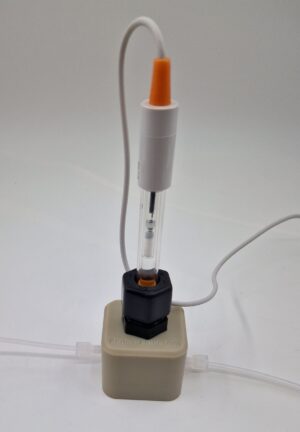
CO2 Electrolysis Accessories, Electrolysis Accessories, ...
395.00 € Add to Quotation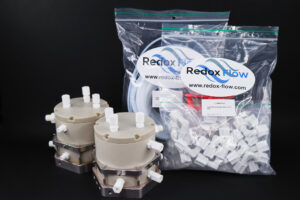
CDI accessories, CO2 Electrolysis Accessories, ...
2,395.00 € Add to Quotation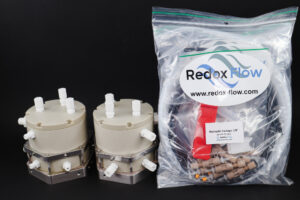
CDI accessories, CO2 Electrolysis Accessories, ...
2,195.00 € Add to Quotation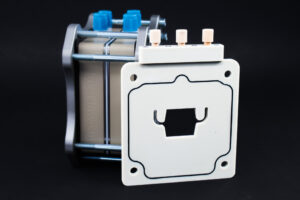
CDI Flow Cells, CO2 Electrolysis Accessories, ...
795.00 € Add to Quotation This product has multiple variants. The options may be chosen on the product page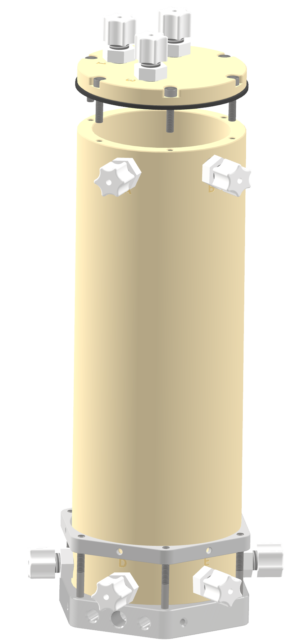
CDI accessories, CO2 Electrolysis Accessories, ...
850.00 € Add to Quotation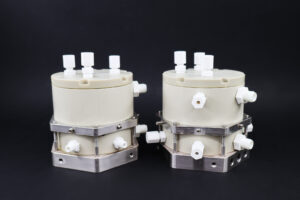
CDI accessories, CO2 Electrolysis Accessories, ...
750.00 € Add to Quotation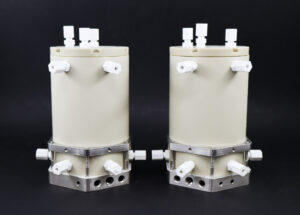
CDI accessories, CO2 Electrolysis Accessories, ...
775.00 € Add to Quotation
CO2 Electrolysis Accessories, Electrolysis Accessories, ...
1,250.00 € Add to QuotationA reliable and efficient CO₂ electrolysis setup requires more than just a high-performance cell. Our range of accessories provides the supporting infrastructure you need to manage fluids, assemble your cell with precision, and ensure the overall integrity of your CO₂RR experiments.
Versatile, chemically resistant beakers designed specifically for flow-battery, electrolysis and CO₂RR research. Each reservoir has nine configurable ports (3 in the lid, 6 in the body) for inert-gas purging, sampling, multi-stream flow arrangements and integration of inline sensors (pH, reference, conductivity). Body and lid are polypropylene (PP), with a PTFE protective film shielding the base so that the electrolyte only contacts inert wetted parts. An integrated stainless-steel heating/cooling plate supports three temperature-control methods: hotplate, up to four heat cartridges, or a circulating heat-transfer fluid — eliminating thermal gradients that would otherwise bias CO₂RR selectivity and Faradaic-efficiency measurements. Port compatibility: 1/8″ or 1/4″ OD tubing. O-rings: EPDM or VITON to match your chemistry. Nominal + ~75 mL headspace on every size; overall heights ~92 mm / ~150 mm / ~270 mm.
Comes in 250mL, 500mL, and 1000mL volumes.
Complete dual-reservoir plumbing kit for single-cell CO₂RR setups. Ships with two multiport reservoirs (customer-selectable 250, 500 or 1000 mL) plus everything needed to build a leak-free, chemically resistant flow loop straight out of the box. Contents include 8 m PTFE hard tubing (1/8″ OD, 1.6 mm ID), 2 m Norprene peristaltic-pump tubing, 8 × PEEK unions, 8 × barbed fittings (1.6–2.4 mm ID), 11 × flangeless nuts, 26 × yellow ferrules, 1 × Y-piece connector, plus a syringe, tube clamps and a tube cutter. Together with the reservoirs you get 18 accessible ports (9 per reservoir), integrated temperature control on both anolyte and catholyte sides, and inert PP/PTFE/PEEK wetted parts — a meaningful upgrade from traditional glass flasks when running alkaline CO₂RR catholytes or long-duration experiments.
Also available with a bottle configuration.
Higher-flow version of the 1/8″ package, engineered for stacked cells and larger-scale CO₂ electrolysis. Same dual-reservoir concept (customer-selectable 250, 500 or 1000 mL) and 18 total ports, but with 1/4″ OD PTFE hard tubing (8 m) plus a 2 m length of 1/8″ PTFE, 1/4″ (#25) and 1/8″ (#14) peristaltic pump tubing, 12 × 1/4″ elbow fittings for compact stack plumbing, 4 × PEEK unions (1/8″), 4 × 1/4″ female fittings, barbed fittings (1.6–2.4 mm), 7 × flangeless nuts, polypropylene 1/8 NPT-to-barb fittings (1/4 ID, 3/16 ID, 5/32 HB), a Y-piece connector, 14 × yellow ferrules, plus a syringe, tube clamp and tube cutter. The larger tubing diameter reduces pressure drop at the flow rates demanded by multi-cell X-Stack or S-Stack configurations.
Also available with a bottle configuration.
Chemically resistant polypropylene insert that converts a standard two-chamber X-Cell into a three-, four- or multi-chamber configuration — essential for CO₂ reduction, Bipolar Membrane Electrodialysis (BMED), multi-compartment electrosynthesis and desalination work. Includes a port for thin reference electrodes (Ø0.8–1.6 mm) for precise potential measurements and two liquid-circulation ports (1/4-28 UNF with ferrules, 1/8″ tubing). Standard 3 mm chamber thickness (expandable with gaskets or custom sizes), stackable so multiple inserts can be used in a single cell. Available for 2.5 × 2.5 cm and 5 × 5 cm active areas.
Multi-functional add-on cell for measuring open-circuit voltage, individual anode/cathode overpotentials, and liquid-phase potentials against an internal reference electrolyte (e.g. V³⁺/V⁴⁺ or Zobell solution — 50/50 ferro/ferricyanide). Purpose-built for researchers who need half-cell diagnostics on a flow loop without redesigning their main cell. Electrolyte contacts only graphite electrodes and corrosion-resistant tubing/fittings; PEEK end plates and a stainless-steel stand complete the construction. Supplied with 1/8″ OD fittings (other diameters on request). Pairs naturally with the multiport reservoirs and the Insert Chamber for three-electrode characterisation of CO₂RR and flow-battery systems. See the linked whitepaper “Measurement of Overpotentials and Liquid Potentials in Flow Batteries” for methodology.
The Flow-Through Electrode Holder installs inline in your electrolyte circuit and accepts standard rod-type electrodes from 3 mm to 17 mm in diameter, enabling continuous monitoring of pH, ORP, conductivity, reference potential, or any other compatible probe measurement without removing electrolyte or interrupting the flow. The polypropylene body is chemically resistant to the acidic and neutral electrolytes used in vanadium and most other flow battery chemistries. The Luggin capillary-type connection geometry gives accurate reference potential readings by positioning the measurement point close to the flowing electrolyte.
A smaller variant (9–12 mm electrode diameter) is also available for labs working with narrower probe formats.
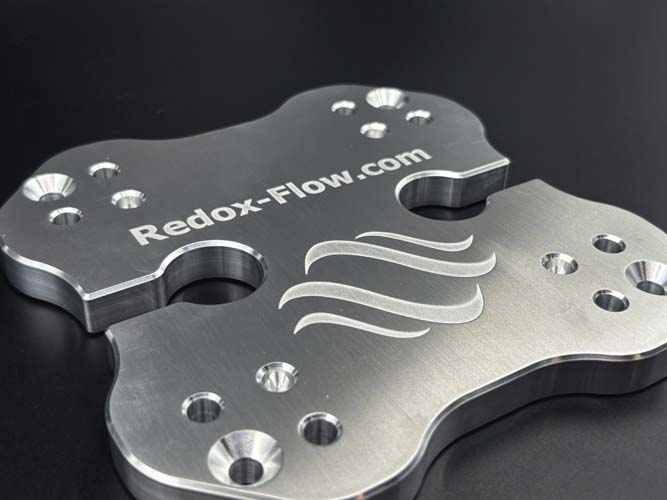
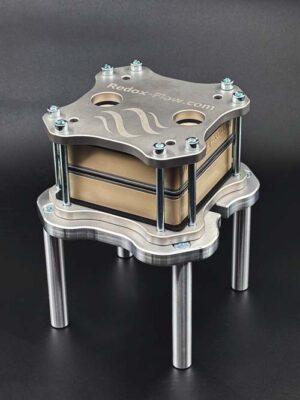
Elevated assembly and disassembly stand that holds X-Cell-family cells in place via the alignment bars while you build, compress or break down the stack. Its key practical advantage for CO₂RR work is that it provides access to the cell ports from the back side — essential for the X-Cell with 3 or 4 compartments and the X-Cell with reference-electrode ports, and it lets you disassemble the cell without removing the tubing, which protects GDEs and membranes from repeated handling damage during teardown and rebuild cycles.
Often yes. Many CO₂RR electrolytes are sensitive to atmospheric oxygen or to CO₂ absorption/desorption, which shifts pH in carbonate buffers and changes local selectivity. Our multiport reservoirs allow continuous inert gas purging, sealed operation and headspace sampling, which is valuable for reproducible long duration experiments.
CO₂ cells typically use gas diffusion electrodes (GDEs), which are porous and mechanically delicate. Uneven compression can crush the microporous layer or leave gas channels, both of which degrade performance and distort Faradaic efficiency measurements. A flow cell assembly stand holds the cell vertically aligned so you can apply uniform, measured compression across the active area before tightening to the specified torque.
Choose 1/8″ for single‑cell CO₂RR experiments where flow rates are modest (typical research scale). Choose 1/4″ for stacked cells or when you need lower pressure drop at higher circulation rates — it ships with 18 ports, elbow fittings and tubing sized for the demands of multi‑cell stacks.
Use the Insert Chamber for Electrolyzer with port for reference electrode. It sits on the catholyte side and provides a leak‑tight port for Ag/AgCl or Hg/HgO references, enabling half‑cell potentials without redesigning the cell.
Yes. The body and lid are polypropylene, a PTFE liner protects the stainless‑steel base plate from any contact with the liquid, and O‑rings are available in EPDM or VITON to match your chemistry. This makes them suitable for the KOH‑ or KHCO₃‑based systems common in CO₂RR research where glass is problematic over time.