Whitepaper V

X-Stacks With Flow Field and Flat Surface Current Collectors

Carried out by the Redox-Flow team
Published in 2026
www.redox-flow.com
Contact
Mikkel Kongsfelt
CEO and Head of Sales
 
sales@redox-flow.com
+45-3126-2040

Introduction


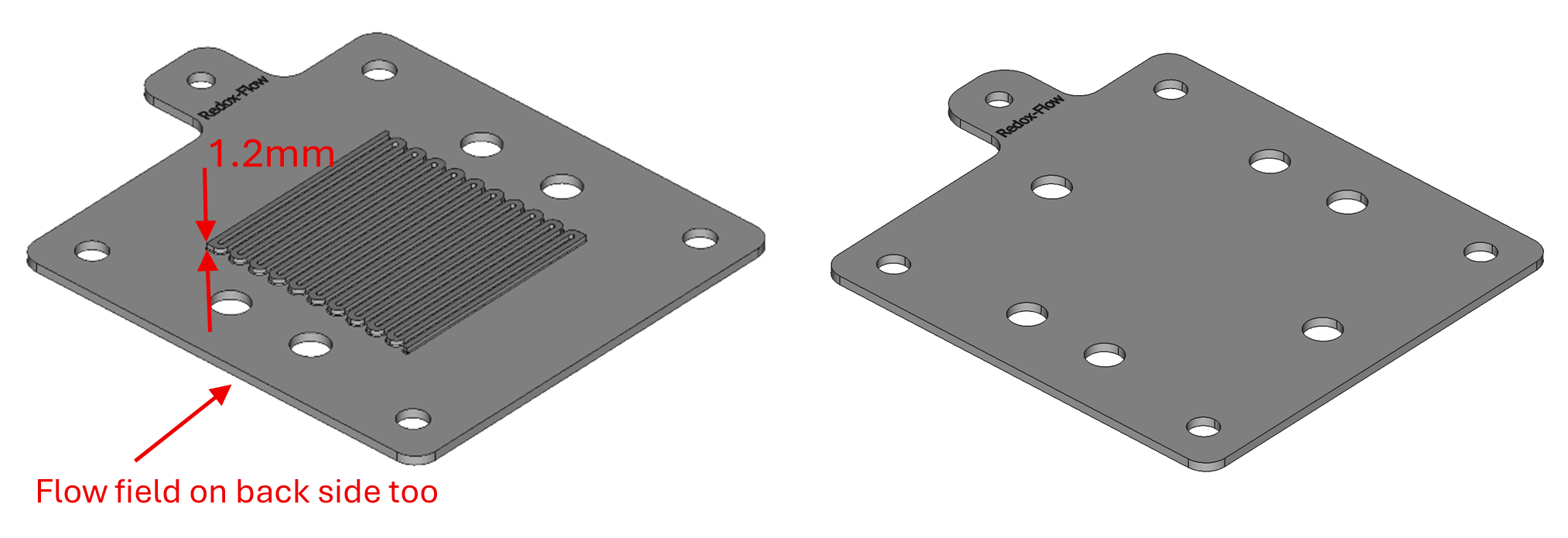
Fig. 1: Left—X-stack-FF bipolar plates with flow fields on both sides; the flow field is elevated by 1.2 mm relative to the plate surface. In contrast, the X-cell’s flow field is machined into the current collector. This design minimizes side reactions, including shunt and corrosion currents. Right—flat surface bipolar plate of the X-stack-flat.

The X-stack-flat is optimized for thick (>1 mm), porous electrodes. For thinner, denser electrodes, higher hydraulic resistance necessitates the use of interdigitated flow fields to reduce flow path lengths. These flow fields also affect mass transfer and bubble removal during electrolysis. This white paper compares the experimental performance of both stack types.

Experimental setup

A series of alkaline water electrolysis tests were conducted using both X-stack-FF and X-stack-flat configurations. The table below summarizes the experimental parameters, including a reference test using the X-cell with flat current collectors.

  X-stack-FF X-stack-flat X-cell (flat)
# cells/active area per cell 6 / 25 cm² 6 / 25 cm² 1 / 6.25 cm²
Current collectors/bipolar plates Ni Ni Ni
Separator Zirfon UTP 500+ Zirfon UTP 500+ Zirfon UTP 500+
Electrode/Area 0.25 mm Ni felt / no compression 1.8 mm Ni foam / compressed to 1.5 mm 1.8 mm Ni foam / compressed to 1.5 mm
Electrolyte/Volume 6 M KOH / 500 mL 6 M KOH / 300 mL 6 M KOH / 100 mL
Flowrate ml/min per side (stack/cell) 100 ml/min / 16.7 ml/min (per cell) 75 ml/min / 12.5 ml/min (per cell) – / 25 ml/min (per cell)
Temperature RT & 80°C RT RT
Hydraulic circuit ¼” OD tubes 1/8″ OD tubes 1/8″ OD tubes

Table 1: Experimental conditions for each setup

Due to the porous nature of the Zirfon separator, dual electrolyte containers cannot be used—minor pressure differences cause liquid crossover. Thus, a single, shared electrolyte reservoir is employed, resulting in mixed (O₂/H₂) gas handling.

Performance Comparison via Polarization Curves

Polarization curves were recorded for the X-stack-FF, X-stack-flat, and X-cell with flat collectors. Currents up to 10 A (400 mA/cm²) were applied in fixed intervals. Voltage values were averaged over the final portion of each constant current period. Table 2 details the specific timing parameters. The cells and electrolyte were used without preconditioning.

  X-stack-FF X-stack-flat X-cell (flat)
Constant current time 30 s 600 s 300 s
Time average for voltage measurement 5 s 60 s 60 s

Table 2: Conditions for recording polarization curves.

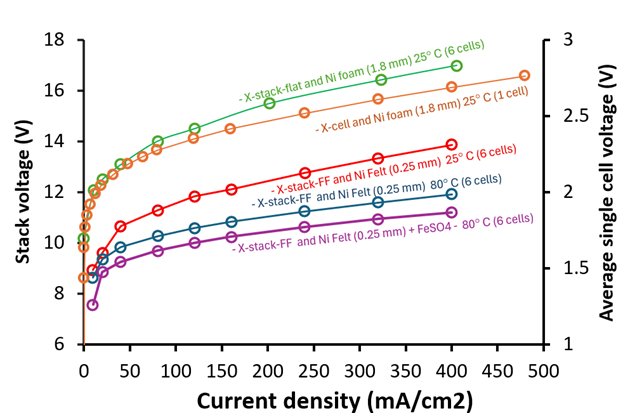
Fig. 2 presents the polarization data. Maximum electrical power for the stacks approached 150 W. The power supply limited the maximum current; higher currents can be supported by the stacks.

Experimental conditions were nearly identical for the X-stack-flat and X-cell, differing only in active area: 6.25 cm² for X-cell versus 6×25 cm² for the X-stack-flat. As expected, the polarization curves are similar, with minor variations attributed to smaller experimental differences.

At 25°C, the X-stack-FF exhibited a 3 V lower stack voltage than the X-stack-flat (0.5 V per cell), largely due to the increased active area and higher density of the Ni felt electrode. While both electrodes are pure Ni, differences in the catalytic activity of the two materials could also play a role. Increasing the X-stack-FF operating temperature from 25°C to 80°C further reduced the stack voltage by nearly 2 V at high current densities, consistent with expectations.

Iron is known to enhance catalytic activity in alkaline water electrolysis (see https://doi.org/10.1016/j.ijhydene.2025.05.262, https://doi.org/10.1016/j.coche.2023.100981 ). To investigate this, 0.2 g FeSO₄ was added to the electrolyte at 80°C. After 60 minutes, a new polarization curve showed an additional 1 V voltage reduction at the highest current density.

Fig. 2: Polarization curves for X-stack-flat at 25°C, X-stack-FF at 25°C and 80°C, and X-stack-FF with FeSO₄ at 80°C. X-cell data are included for comparison. Left axis shows total stack voltage; right axis shows per-cell average voltage.

All tests were conducted ‘as-is’ with no performance optimization attempts (e.g., electrode type, compression, or electrolyte modification).

Individual cell voltage monitoring

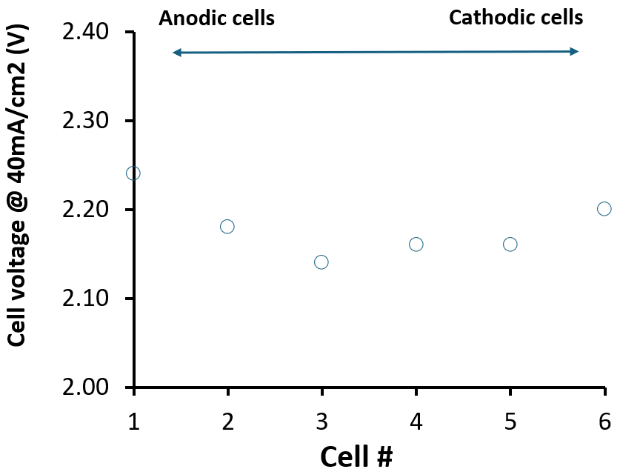
The design of the X-stacks enables easy measurements of the individual cell voltages. Fig. 3 shows individual cell voltages when the X-stack-flat is operated with 40 mA/cm2 at 25° C (same experimental setup as in fig. 2/table 1). End cells exhibit higher voltages, likely due to lower shunt current contributions compared to central cells.
Fig. 3: Individual cell voltages in X-stack-flat at 40 mA/cm² and 25°C.

In addition to assessing shunt currents, individual cell voltage measurements enable evaluation of electrode degradation, corrosion, and scaling effects.

Faradaic efficiency

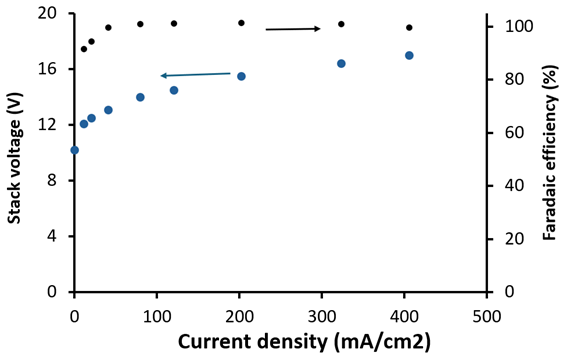
Faradaic efficiency was measured for the X-stack-flat at 25°C. As shown in Fig. 4, efficiency increased from ~90% at 10 mA/cm² to nearly 100% above 50 mA/cm², confirming minimal shunt currents due to well-designed flow channels. These values represent a lower bound, given the non-optimized electrode configuration. Estimated uncertainty: ±3%. Efficiency was determined by gas volume via water displacement.

To ensure that the stack design does not come with high shunt currents, the Faradaic efficiency of the X-stack-flat at 25° C (same experimental setup as in fig. 2/table 1) was measured. These data are plotted in fig. 4. It is seen that the faradaic efficiency increases from about 90 % at 10 mA/cm2 to approximately 100 % faradaic efficiency >50 mA/cm2. The faradaic efficiency confirms minimal shunt currents due to well-designed flow channels. Also the faradaic efficiency measured represent a lower bound, given the non-optimized electrode configuration. Estimated uncertainty: ±3%. Efficiency was determined by gas volume via water displacement.

Fig.4: Polarisation curve for the X-stack-flat (same data as in Fig. 2) left y-axis and faradic efficiency right y-axis.

Pressure loss in X-stack-FF

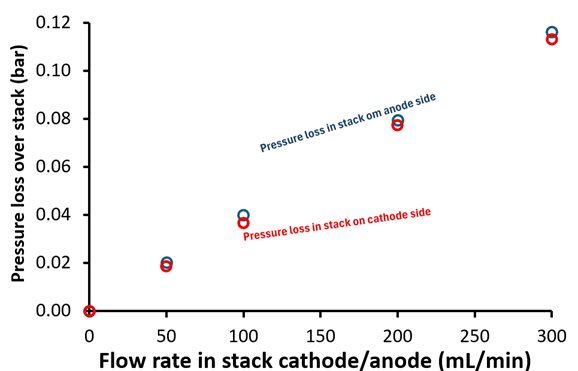
In the X-stack-FF 0.25 mm thick electrodes was used, if these were used in the X-stack-flat, this would have lead to an extremely high pressure loss in the stack because the electrode is very thin and dense. To confirm that the pressure loss in the X-stack-FF (current collectors with interdigitated flow field) is in an acceptable range, it was measured using Redox Flow pressure units, that are placed at the stack hydraulic inlet and outlet.
Fig.5: Pressure loss over X-stack-FF with 6 cells and water at 25 C as function of the flow rate (individual flow rates for each side).

Fig. 5 shows the pressure loss test in the stack with pure water at 25°C. As seen the pressure loss is very small, in particular this is due to the small thickness of the electrode and the interdigitated flow fields on the bipolar plates. In this case the total pressure loss inside the stack, consists of small contributions from the flow channels in the PEEK flow body, stack manifold, shunt channels before the electrodes and the electrodes by themselves.

Although tests were done with water, similar results are expected for other electrolytes and temperature ranges and in particular excessive pressure losses (> 0.5-1 bar) inside the stack is not expected.

Temperature control

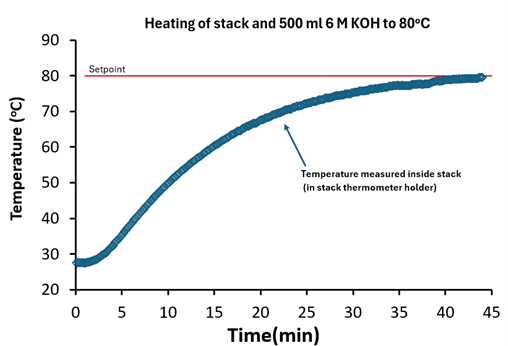
A Redox Flow heating unit was used to heat the X-stack-FF under the conditions in Table 1. The temperature of the stack was measured with a thermometer in the thermometer holder inside the stack. The temperature profile when the stack and electrolyte is heated from 25°C to 80°C is shown in Fig. 6. It is seen that the stack and 500 mL electrolyte reaches the 80° C  setpoint within less than 45 min.

Fig.6: Temperature profile of the stack (measured with a thermometer in the thermometer holder inside the stack) versus time.

Summary

The X-cell and X-stack product family from Redox-flow.com represents a uniquely versatile and comprehensive platform for electrolysis R&D. This modular system spans from single cells with an active area of 6.25 cm² to multi-cell stacks with up to 25 cm² per cell, with configurations scalable to nearly 200 cm² in total active area.

Key features include:

  • Interchangeable current collectors – Available as flat surfaces or with interdigitated flow fields, enabling operation with both very thin and thick electrodes. This supports studies on mass transfer, bubble transport, and electrode optimization.
  • Individual cell voltage monitoring – Facilitates advanced diagnostics such as analysis of shunt currents, corrosion effects (in stacks), overall electrode degradation, and system upscaling.
  • Polymer-based system design – All components apart from current collectors and electrodes are made from polymers, allowing critical investigations of metal ion impurity effects on catalytic properties and electrode performance.
  • Integrated testing accessories – Accessories like the heating unit and inline pressure sensors support testing under elevated temperatures and facilitate measurement of the hydraulic characteristics of electrodes and bipolar plates.

Together, these features provide a complete, adaptable R&D environment for rigorous investigation and optimization of virtually any type of electrolysis system.


Interested? We’d like to hear from you!

Don’t hesitate to contact us with any kind of inquiries at
sales@redox-flow.com or call Mikkel Kongsfelt at +45-3126-2040

Mikkel Kongsfelt