
Introduction
Understanding and managing pressure losses in tubing and electrochemical units is essential for ensuring optimal performance and reproducibility in electrochemical flow systems. We are often asked about best practices and design considerations regarding pressure drop. While the final configuration must be tailored to your specific application, this white paper provides guidance and insight to support more informed decision-making.
Tubes
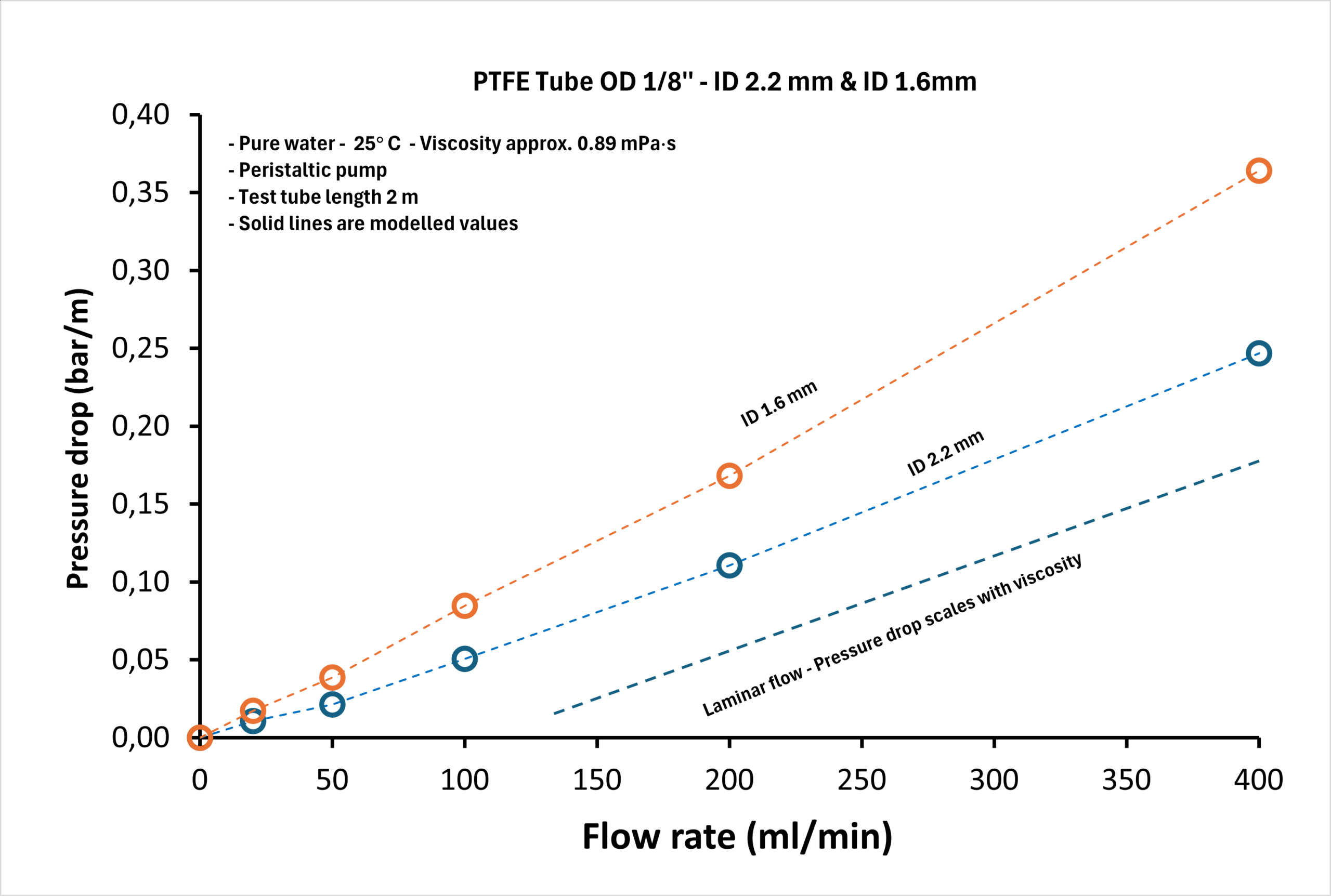
At Redox-flow.com, we offer three standard tubing sizes, listed with their outer (OD) and inner diameters (ID):
- 1/8’’ OD – 1/16’’ (1.6 mm) ID
- 1/8’’ OD – 2.2 mm ID
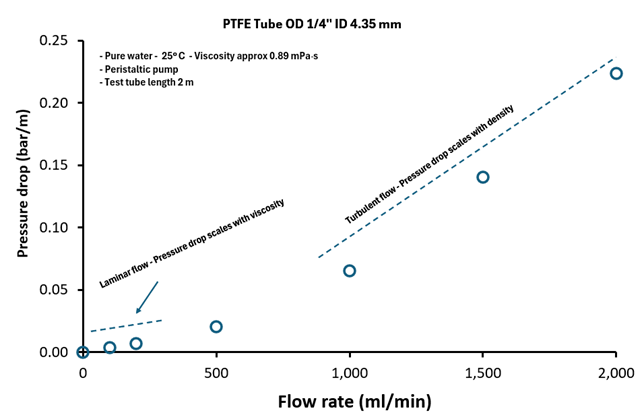
- 1/4’’ OD – 4.35 mm ID
The pressure drop per meter of tubing is shown in the graphs below as a function of flow rate. These measurements were taken using pure water at room temperature. However, it is important to note that pressure loss is influenced by:
- Fluid viscosity (large dependence on temperature),
- Fluid density (small dependence on temperature, but large dependence on dissolved salt/chemicals)
- Flow regime (laminar vs. turbulent)
Flow Regimes and Pressure Drop
The pressure loss depends on the viscosity (temperature) and density of the fluid and whether it is in laminar or turbulent flow range. For
- laminar flow range, the pressure drop is proportional to the viscosity,
- turbulent flow range the pressure drop is proportional to the density of the fluid.
To estimate pressure drop for a given setup, determine whether the flow is laminar or turbulent using the Reynolds number (Re):
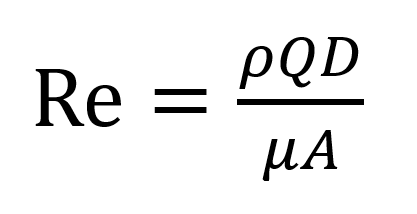
Where is the density of the liquid,
is the flow rate and
is the diameter of the tube,
is the dynamic viscosity of the liquid and
is the cross-sectional area of the tube.
Guideline values:
- Re < 2300 → laminar flow
- Re>2900 → turbulent flow
Then scale with either density or viscosity of the liquid according to the graphs.
Depending on the tubing length and application, redox-flow.com recommends keeping pressure losses below 0.1–0.2 bar/m.
Electrochemical Cells
Redox-Flow.com electrochemical cell types (A, S, and X) are designed to minimize pressure drop at the hydraulic inlet and outlet. However, the total pressure drop depends entirely/significantly on the electrodes used. Here redox-fow.com general recommendations are:
- For thin electrodes (<1 mm thickness): Use current collectors with interdigitated flow fields to improve distribution and reduce pressure drop.
- For thicker electrodes (>1 mm thickness): Current collectors with flat flow fields can be used, although performance heavily depends on the intrinsic hydraulic resistance of the electrode material.
Redox-Flow.com also provides tools and units that allow direct measurement of the hydraulic resistance of different electrodes to support empirical testing and optimization.
Inline/Electrochemical Units
This section applies to inline units using ¼-28 UNF fittings (commonly known as IDEX fittings for 1/8’’ OD tubing).
We offer a variety of inline units for integration of:
- Reference electrodes
- Pressure sensors
- UV/VIS detectors
- And more
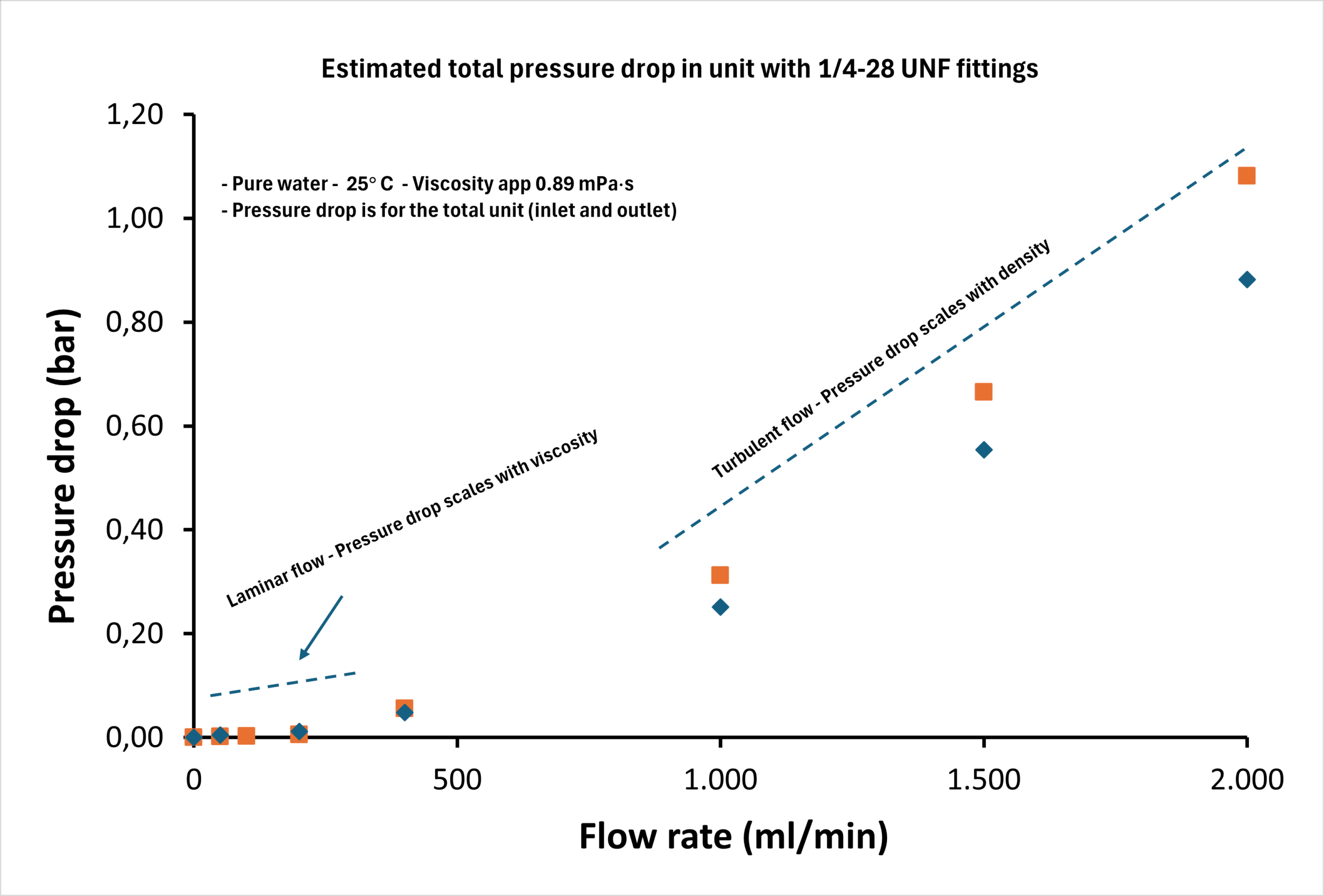
In these units, pressure drop is largely governed by the fitting and related orifice restrictions. The accompanying graph illustrates pressure losses for two representative units. As observed, pressure loss increases substantially beyond 400 mL/min. For applications requiring flow rates > 500 mL/min, we recommend reaching out to Redox-flow.com to discuss customized solutions.
Interested? We’d like to hear from you!
Don’t hesitate to contact us with any kind of inquiries at
sales@redox-flow.com or call Mikkel Kongsfelt at +45-3126-2040

Mikkel Kongsfelt