
Whitepaper IV
Experimental Investigation of Hydraulic Shunts, Liquid Potentials, and Shunt Currents in Vanadium Flow Battery Stacks
Mikkel Kongsfelt
Introduction
- Stack Cycling & effect of hydraulic shunt on capacity fades
- OCV cell data – Liquid half-cell potentials
- Stack polarization curve & individual cell voltages
- Shunt currents in flow battery stacks
- Effect of shunt currents through OCV cell
Experimental setup
- Stack: Redox-flow.com S-stack with 6 cells
- 25 cm² active area per cell
- Thermally activated AVCarb G475 carbon felt electrode, compressed from 4.7 mm down to 3.5 mm with flow field gasket of 1.5 mm and two cover gaskets of 1 mm
- Fumatech FS930 cation exchange membranes
- 10 A/10V battery tester with 8 AUX voltage and temperature logging for reference electrodes and individual cell voltage measurements
- Redox-Flow.com Multiport Reservoirs (2 x 250 mL) for electrolyte containers
- Standard 1.6 M vanadium electrolyte – 210 mL used for both anode and cathode side – total 9005 mAh capacity = 1501 mAh 6 cell stack capacity
- Redox-flow.com OCV cell with internal reference
- Redox-flow.com peristaltic pump with three pump heads
- Two heads are fitted with #25 peristaltic tube and a flow of 240 ml/min (40 ml/min per cell) – used for the main hydraulic circuit of the stack
- One head is fitted with a #14 peristaltic tube and a flow of 25 ml/min – used for the hydraulic circuit of the reference for the OCV cell
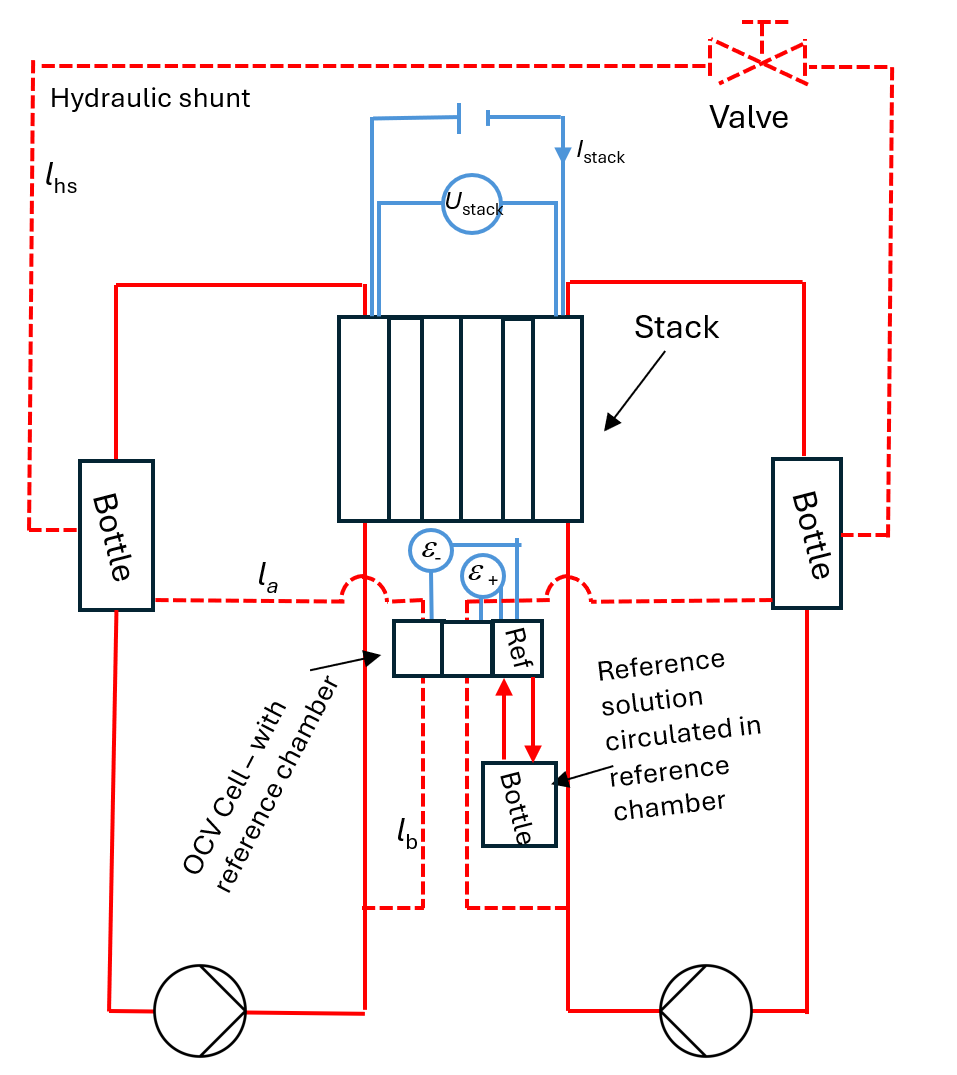
The OCV cell is connected with a T before the stack through 1/8″ OD (1.6 mm ID) PTFE tube, while after the OCV cell it is connected directly to the reservoir. The length of the 1/8″ OD tube before the OCV is denoted lb and after it is denoted la. Rather than connecting the OCV directly in the main hydraulic circuit (as in white paper Measurement of Overpotentials and Liquid Potentials in Flow Batteries), this approach has been selected because (i) the OCV cell has a relatively high hydraulic resistance and flow rates > 200 ml/min can lead to relatively high pressure losses in the OCV cell, and (ii) because of a much higher stack voltage compared to single cells, shunt currents through the OCV cell will significantly affect the voltage readings from the OCV cell. For that reason the length of the OCV hydraulic circuit is lb ~100 cm and la ~10 cm. Out of the total flow of 240 ml/min from the pump, the flow through the OCV cell was measured to approximately 15 ml/min, whereby the true flow rate inside the stack is only 225 ml/min. The ratio between the two flow rates is not constant and will depend on la+ lb and hydraulic resistance of the stack. But it can be measured by disconnecting the la tube from the reservoir and measure the transferred volume into a separate bottle over e.g. 1 minute.
Stack Cycling & Effect of Hydraulic Shunt on Capacity Fades
In the present experiment, the electrolyte was not purged with inert gas prior to operation. Consequently, some initial oxidation occurs during the first cycles. However, because the multiport reservoirs are leak-tight, this oxidation is limited to the oxygen initially present in the system. After the first few cycles, capacity fade is therefore dominated by vanadium crossover.
| Self discharge mechanism | Model | Estimated self-discharge current (electrolyte) |
| Electric potential difference driven shunt currents (migration) | 40 cm shunt channel leads to an ionic resistance of 7kΩ | ~0.2 mA |
| Time delays in the electrochemical and hydraulic system | Diffusion through 40 cm shunt | << 0.2 mA |
| Measure before / after electrochemical cell | Osmotic and electro-osmotic effects – 0.5 mL/hour electrolyte transfer | ~25 mA |
Table 1
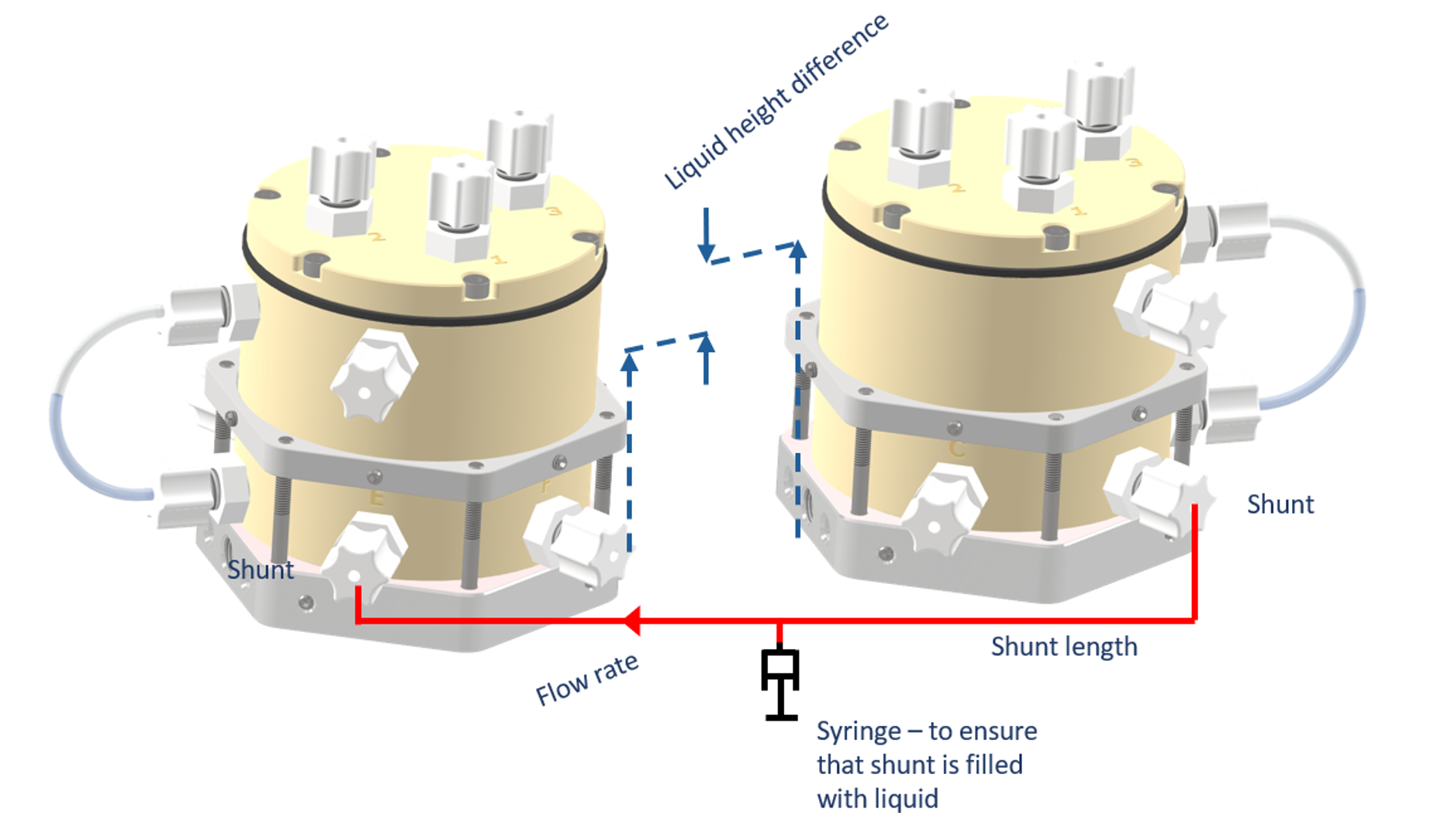
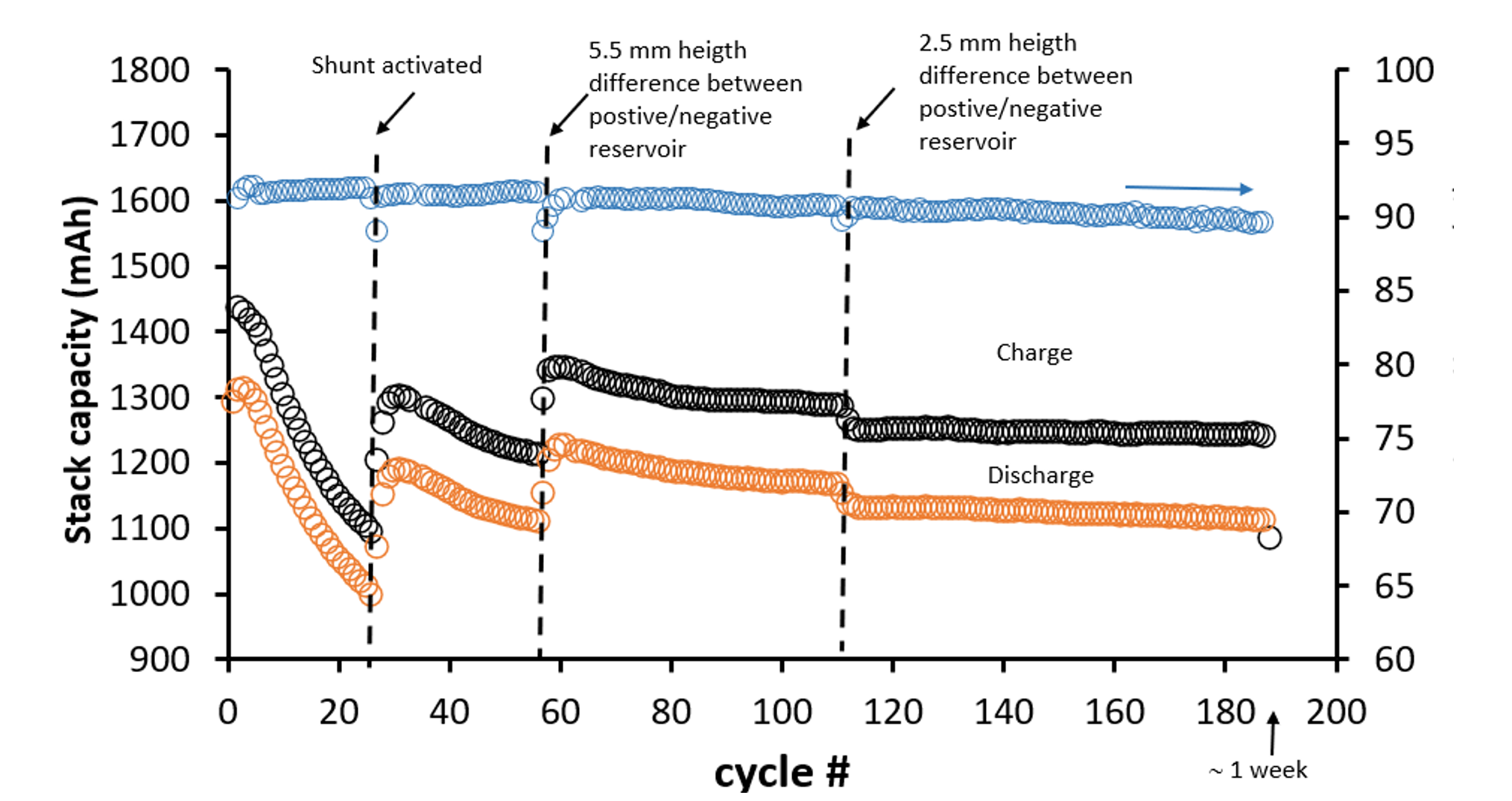
Opening the hydraulic shunt leads to a reduction in faradaic efficiency from approximately 92.0% to 91.5%. Given an average cycle duration of 45 minutes, this corresponds to an increase in stack-level self-discharge current of roughly 9 mA, equivalent to approximately 56 mA on an electrolyte basis. Migration- and diffusion-driven shunt currents are estimated to be below 0.2 mA and are therefore negligible. The dominant contribution arises from volumetric electrolyte transfer driven by osmotic and electro-osmotic effects, estimated at approximately 0.5 mL/h-1. Considering experimental uncertainties and the simplicity of the models, the observed decrease in faradaic efficiency is consistent with this mechanism.
To further demonstrate the flexibility of the multiport reservoir system, additional tests were conducted in which the relative heights of the two reservoirs were deliberately adjusted. From cycle 57, the positive reservoir was elevated by 5.5 mm relative to the negative reservoir, resulting in approximately 28 mL additional electrolyte on the negative side. This led to an immediate increase in capacity, which stabilized at around 1200 mAh until cycle 110. Subsequently, the height difference was reduced to 2.5 mm (corresponding to approximately 12 mL volume difference), producing a small but immediate decrease in capacity, after which stable cycling was again observed.
OCV cell data - Liquid half-cell potentials
In addition to the normal stack/cell I and U monitored during the charging, the setup was also equipped with an OCV cell that can measure both the liquid potentials and overpotentials for each side as described in white paper Measurement of Overpotentials and Liquid Potentials in Flow Batteries. However, in the case of a combination of a stack (rather than a single cell) and an OCV cell, it is not possible to measure the overpotentials individually for each side as the OCV cell measures the potential of the common electrolyte and not the potential of the electrolyte inside each cell of the stack.
In principle the total stack overpotential can be approximated/calculated by subtracting Nstack = Ustack– 6xUocv, depending on the definition of the overpotential, it should include/not include the effects of shunt currents between the cells in the stack. In any case, this is out scope of the current white paper and for this reason only liquid potentials are shown in the following and using the same definitions of the energy levels as in paper Measurement of Overpotentials and Liquid Potentials in Flow Batteries. Also it is noted that the reference chamber is not placed in the center as in the previous white paper, but in the side chamber, whereby the order in the OCV cell is Negolyte → Posolyte → Reference. Extended test (not shown) of the OCV cell has shown that the order of the chamber does not play a crucial role on the stability and accuracy of the OCV cell data. On the other hand there can for reasons of cross-over in membranes in the OCV cell or compatibility of reference solutions with either the anolyte or catholyte be good reasons for changing the order of the solutions in the OCV cell.
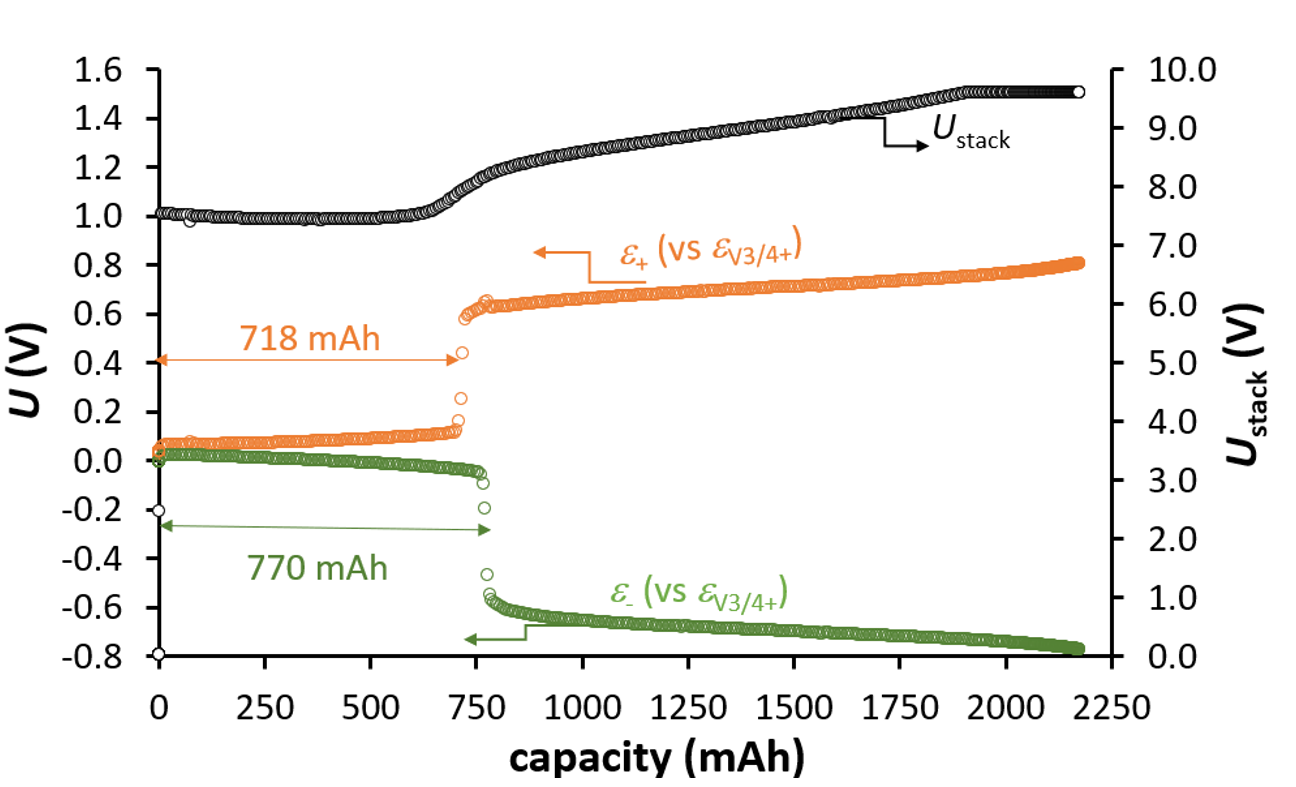
The data shown in Figure 4 shows the liquid redox potentials of the solutions (ε- and ε+) and stack voltage as a function of capacity in the first cycle where the vanadium is charged from its pristine state (50%/50% V3+/V4+) to 100% SOC. The charging is 3.75 A constant current followed by constant voltage (9.6 V) and finally terminated by a cut-off current of 0.5 A.
It is seen that the negolyte and posolyte potentials decrease/increase slowly from values of about 0 V (vs. εV3/4+ because the pristine vanadium solution is used as reference solution in the OCV cell). A large decrease and increase is observed at 770 mAh and 718 mAh for the negolyte and posolyte, respectively. This plateau is related to charging V4+ to V3+ and V3+ to V4+ on the negative and positive side, respectively.
In the ideal case where the pristine V3+/4+ solution is fully balanced 50%/50%, there is exactly 210 mL of electrolyte in each reservoir and the membrane in the stack is fully selective (i.e. no vanadium cross-over) this number should be identical and half of the theoretical capacity of 1501 mAh/2 = 750 mAh. It is out of the scope of the present white paper to understand this difference in detail. However, from specs of the vanadium electrolyte, it should be balanced within ±2% and volumes are measured with < ±1% accuracy and cannot explain the difference. Oxygen/air in the (negative side) reservoir should have little effect as air only reacts with V2+, but could nonetheless explain the slightly larger value for the negative side. However, most likely is that it is due vanadium cross-over. All vanadium species are positively charged and for this reason migration will be from the positive side to the negative side during the first initial charging cycle. As seen from Figure 4 larger quantities are reduced on the negative side.
Another example of the unique information and benefits from mapping out liquid potentials is shown in Figure 5, which shows the negolyte, posolyte, and stack voltage (ε-,ε+, and Ustack) during charge and discharge for cycles 3, 25, 60 and 180. The purpose of this example is to demonstrate that by mapping out the liquid levels it is possible to explain the behavior of the capacity fades/increases shown in Figure 3.
During the repeated cycling of the battery, it is obvious that vanadium quantities on each side are changed either by vanadium cross-over inside the stack or by external change of the volumes on each side. Hereby one side becomes the capacity limiting side and determines the overall capacity of the battery. However, as the vanadium concentrations are different on each side, it is not possible just from the volumes on each side to determine the vanadium capacity; however, these can be observed from the liquid potentials.
From cycle 3 it is seen that upon charging both negative side and positive side show a Nernstian upturn at the highest capacities, while during discharge both sides shows a clear Nernstian downturn when almost fully discharged (slightly more pronounced for the negative side) and shows that anolyte/catholyte is close to being balanced (i.e. same amount of vanadium on both sides and fully 3+/4+ at 0% SOC and fully 2+/5+ at 100 % SOC) and in agreement with this cycle being the one with the largest capacity.
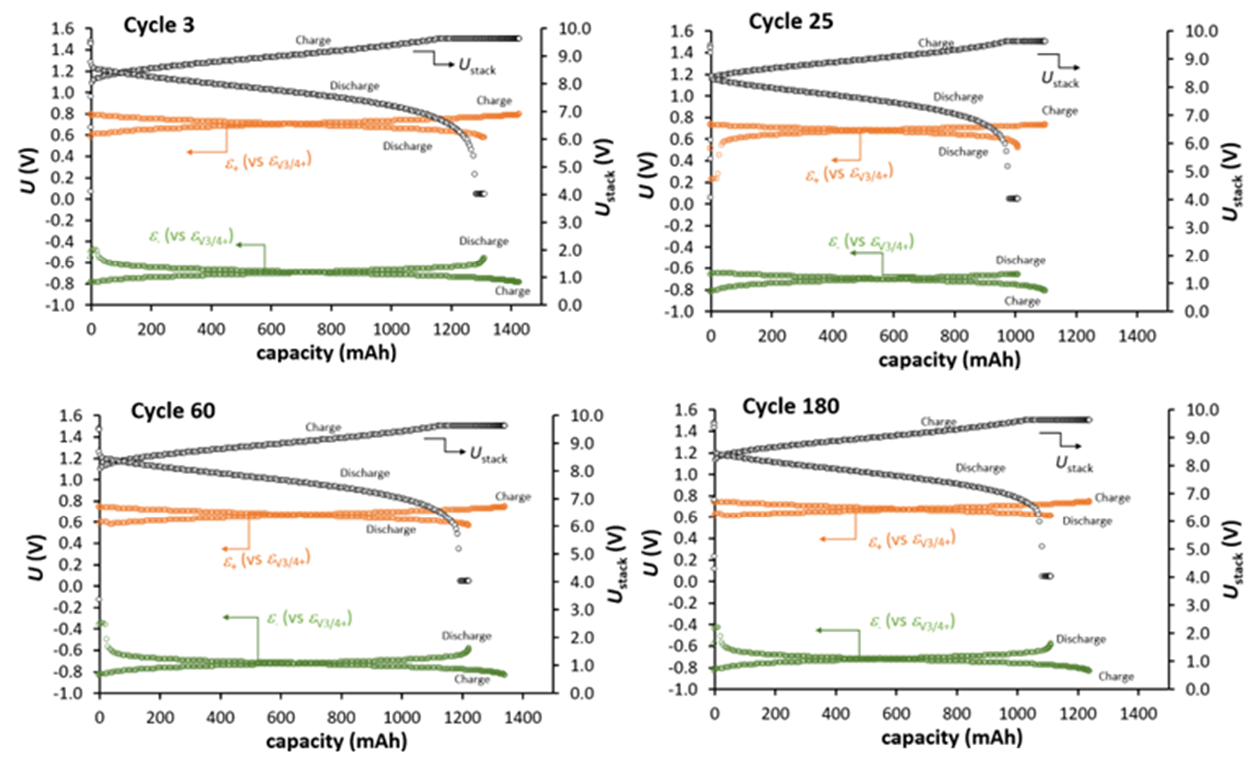
In cycle 25 (top right panel in Figure 5) the capacity reaches the lowest overall capacity of about 1000 mAh. It is clear that the negative side is the capacity limiting (Nernstian downturn of εₙ around 1100 mAh), while it is the positive side that is capacity limiting on discharge (Nernstian downturn of εₚ around 1000 mAh). This indicates that vanadium overall has been transported to the positive side and in the same direction as the volume transfer that goes towards the positive side. Once the shunt is opened (after cycle 25) capacity is restored because vanadium is transported from the positive to the negative (capacity limiting) reservoir through the shunt.
As suggested by the results of the shunt, the capacity is limited because vanadium is continuously being transported to the positive side. This suggests that if the positive side reservoir is vertically elevated relatively to the negative reservoir, the difference in total vanadium amounts on each side can be balanced out by the height difference. After cycle 56 the positive side reservoir is raised 5.5 mm to the negative reservoir and after cycle 111 to 2.5 mm. From the bottom discharge plots in Figure 5, the potentials shows that for both cycle 60 and 180 the negative side is the capacity limiting side on both charge and discharge. Comparing this to the capacity of cycle 60 (about 1250 mAh) it is seen that it is higher than that of cycle 180 (about 1100 mAh), this suggest that the optimal height difference for balancing the vanadium between the two reservoirs is higher than 5.5 mm.
Again the scope of the present white-paper is not to optimize and find the most optimal conditions, but to demonstrate the capabilities of combining the S-stack with the OCV-cell and multiport reservoir.
Temperature during cycling
steps of 0.15℃. Nonetheless, it is seen that the ambient temperature is about 24.2°C through out the cycle, while the cell increases about 2°C from 26°C to 28°C during charge and decreases equivalently from 28°C to 26°C during discharge. It is fully expected that the temperature of the cell/electrolyte is higher during cycling due to joule/ohmic heating. However, the cycling of the temperature is related to the entropy effects, where charging results in a negative change of reaction entropy and therefore cools down and discharging the reaction entropy is positive and leads to heating.
Stack polarization curve & individual cell voltages
For this reason the polarization curve is measured by constant current in 10 s followed by instant jump to next current (without rest in between). The polarization curve is constructed from the electrical current and voltage at the last data point in the 10 s sequence. Even with these short sequences there is a significant SOC change during the test and for that reason the data in Figure 7 has been corrected with the change of the OCV measured in the OCV cell. The maximum correction is 150 mV at the most negative stack current.
The polarization curve shows a linear tendency and from a linear fit a stack area specific resistance of 4.68 Ωcm² (Rᵢ = 0.187Ω) is found. The maximum power during charging is about 65 W and limited by the maximum charging voltage of 9.6 V. The maximum power during discharge is equally about 65 W and is limited by the discharge current of the battery tester (10A). From the stack internal resistance (Ri) and stack OCV the maximum discharge power is estimated to be about 95 W (Pmax=OCV2/(4Ri) ) @ 22.5A. It is underlined that it is for the specific temperature and SOC only.
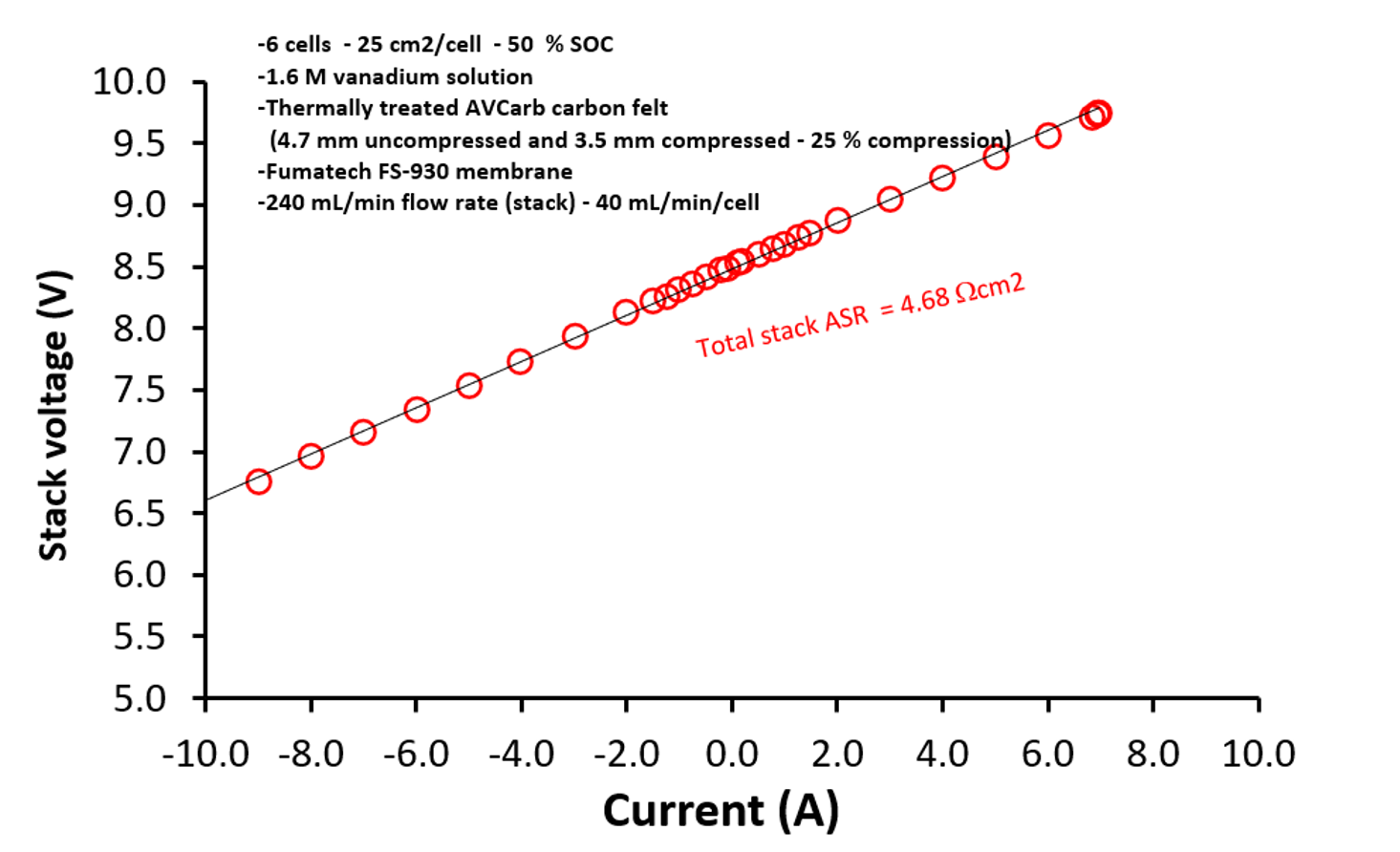
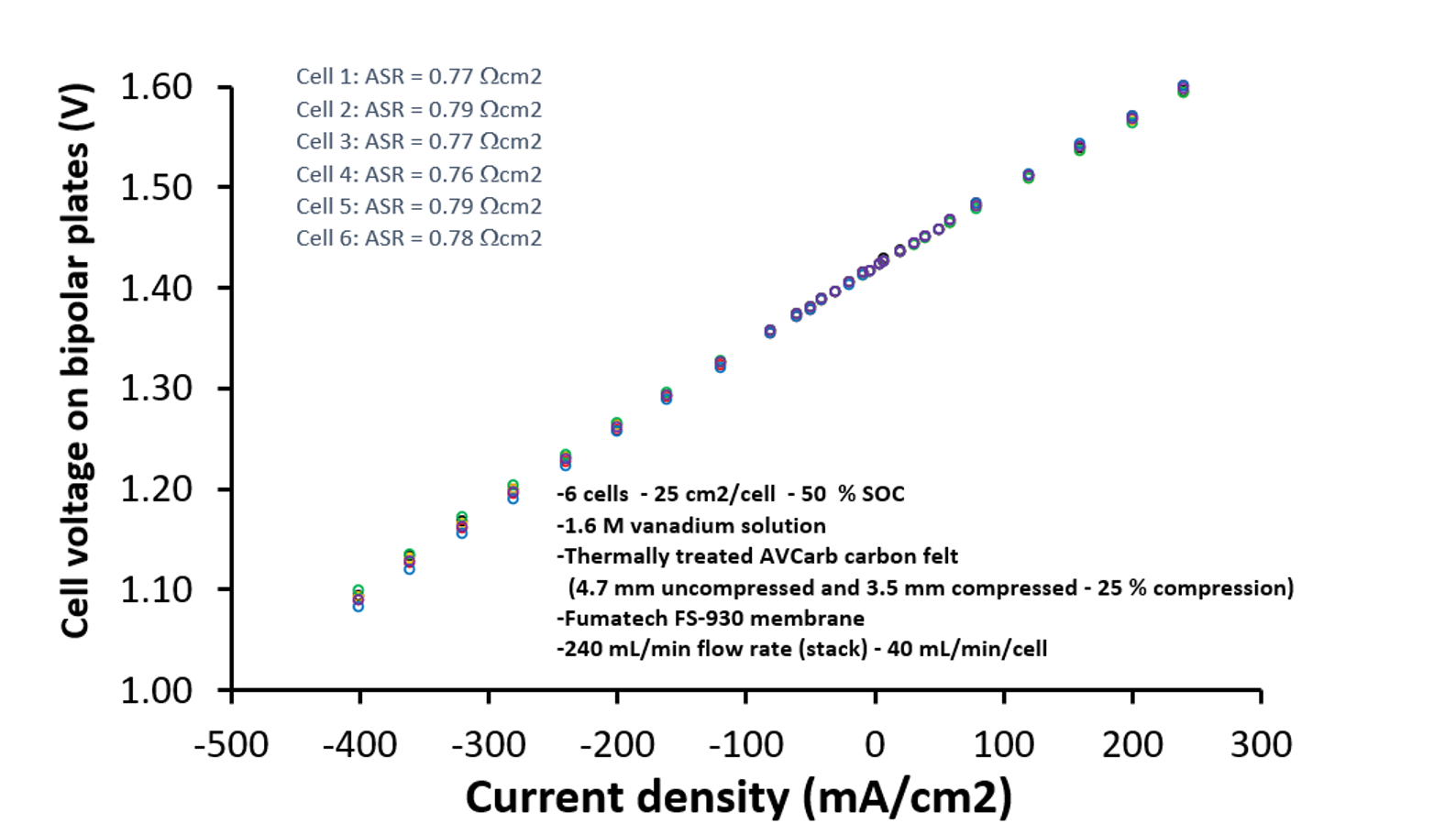
Figure 8 shows the individual cell voltages during the measurement of the polarization curve at 50%. As for the stack polarization curve, they have been SOC corrected from the OCV measurement. All cells have been corrected with the same values and the maximum correction is 150 mV/6 = 25 mV. As seen all cells show a linear behavior where the ASR is in the range 0.76 Ωcm² to 0.79 Ωcm² and very close to each other. The values are slightly higher than single cell tests measured in the S cell (0.56 Ωcm² in white paper Measurement of Overpotentials and Liquid Potentials in Flow Batteries). However, in this test flow rates were higher and compression larger, both leading to lower ASRs and in agreement with present test.
The variation of the voltages between individual cells3 shows a maximum at the highest discharge current (-400 mA/cm2, 10A) where the variation is 17 mV and cell voltages are in the range from 1096 mV (cell 4) to 1079 mV (cell 5). However, more importantly during maximum charging current (280 mA/cm2) where difference individual cell voltages/performance can lead to acceleration of corrosion and unwanted side reactions, the maximum variation is only 11 mV (1629 mV cell 5 and 1618 mV cell 4). For moderate current densities in the range -160 mA/cm² to 160 mA/cm², the largest variation among any of the cells is only 5 mV (1291 mV cell 1 and 1286 mV cell 5). The variations are very small and demonstrate that performance between individual cells in the stack is reproducible among different cells.
The gaskets used in the assembly of the S-stack are based on gaskets with large manifold diameter (ø4) and wide shunt channel width (3.5 mm); this increases shunt currents. If an application requires very low shunt currents, gaskets with smaller manifold diameter (ø3) and smaller shunt channel width (2 mm) can be used. However, tests (not displayed) has shown that larger differences between individual cells can occur. This is attributed to larger and varying hydraulic resistance of the manifolds/channel because of geometric tolerances of the channels when stack is assembled. This leads to variations of the flow in individual cells, which again leads to different performance/voltages in individual cells.
Shunt currents in flow battery stacks
In redox flow batteries electrochemical cells are connected in series to form a stack to increase the overall operating voltage. In most stacks this is obtained by distributing the electrolytes in parallel hydraulic circuits through common manifolds in the stack. However, the presence of electrically conductive electrolytes in shared manifolds creates unintended ionic current paths between cells. These parasitic currents, known as shunt currents, arise because adjacent cells operate at different electric potentials, which drives ionic currents between individual cells through the manifold. Shunt currents are undesirable because they directly reduce the faradaic (and energy) efficiency of the stack. In addition, shunt currents can lead to high local potentials in cells and manifolds, which may accelerate corrosion inside the stack.
A common mitigation strategy is to introduce shunt channels between each cell and the manifolds. These narrow channels increase the ionic resistance between cells, thereby reducing shunt current magnitudes. However, this approach introduces a trade-off between increasing ionic resistance that lowers shunt losses but simultaneously increases hydraulic pressure losses, leading to higher pumping power and reduced system efficiency. Stack design therefore requires careful optimization of channel geometry to balance electrical and hydraulic performance.
Direct experimental measurement of shunt currents inside operating stacks is challenging. Consequently, shunt-current modeling is the most widely used approach to quantify and analyze these losses. Among available methods, the resistor network/equivalent resistor model is particularly attractive because of relative simplicity.
In a resistor network model, the stack is represented as a network of electrical resistances describing ionic current paths through the electrolyte. Each cell is assigned an electrochemical potential, and shunt currents arise due to potential differences between neighboring nodes. The key parameters are:
- Rₛₕ: shunt channel resistance between a cell and a manifold
- Rₘ: manifold segment resistance between adjacent cells
- κ: ionic conductivity of the electrolyte (S m⁻¹)
- Geometric parameters of channels and manifolds
By applying Kirchhoff’s current and voltage laws to this network, the shunt currents in each channel and manifold segment can be calculated. In the context of Redox-flow.com flow battery S-stack, Rs and Rm are defined by the geometry of the gaskets used in the stack and shown in Figure 9. The cell inlet/outlet shunt channels are defined by the channel length (Lsh), channel width (w), and channel height (h), filled with electrolyte of conductivity κ, the ionic resistance is given by
Rs = Lsh / (κ · w · h)
Similarly, the resistance of a cylindrical manifold segment of length Lm and inner diameter d is
| Rm = Lm / (κ · Am) | with the cross-sectional area | Am = πd2 / 4 |
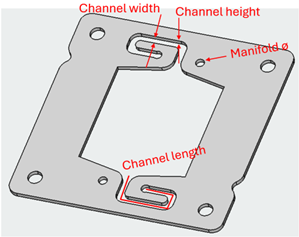
Typical shunt channel dimensions in gaskets in Redox-flow.com stacks are shown in the table below. Here the shunt channel resistance (Rsh) is calculated for 50 mm channel length (common for all gaskets) and two typical heights and widths. The electrolyte conductivity is assumed to be 280 mS/cm and taken as a typical average for vanadium flow battery electrolyte solution. It is seen that Rₛ is typically in the range 250–600 Ω.
| Shunt channel resistances (κ = 280 mS/cm) | ||||
|---|---|---|---|---|
| Case | Channel length (mm) | Channel height (mm) | Channel width (mm) | Shunt channel resistance / Rs (Ω) |
| S1 | 50 | 1.5 | 2 | 595 |
| S2 | 50 | 1.5 | 3.5 | 340 |
| S3 | 50 | 2 | 2 | 445 |
| S4 | 50 | 2 | 3.5 | 255 |
Equally the typical manifold diameter of Redox-flow.com stack is 3mm or 4 mm. The length depends on the configuration but typically 7mm, which leads to Rm in the range 20 – 35Ω.
| Manifold resistances (κ = 280 mS/cm) | |||
|---|---|---|---|
| Case | Manifold length (mm) | Manifold diameter (mm) | Manifold resistance / Rm (Ω) |
| M1 | 7 | 3 | 35 |
| M2 | 7 | 4 | 20 |
Redox-Flow.com has developed a Python code that solves the non-linear equations for the equivalent resistor network model. The model has many output parameters, but in the present white paper it is the impact of the shunt current on the Faradaic efficiency that is in focus. These results (Figure10) shows the average shunt current as function of the number of cells in the stack for all combinations of Rs and Rm in the tables above.
The average shunt current is defined as the sum of shunt currents between all cells divided by the number of cells in the stack and is thereby a ‘measure’ of the self discharge current and Faradaic efficiency. As an example, the stack cycling data shown in Fig 3 is for a stack with gaskets where Rm = 20 Ohm, Rs= 340 Ohm and 6 cells. From top panel of Fig 10 it is seen that for this configuration, the average shunt current is about 40 mA. If the stack is charged/discharged with 3.75 A, as in the experiment, the corresponding faradaic efficiency (FE) for the cycle would be FE = 100% – 2×40 mA/3.75 A = 97.9%.
Here the x2 multiplication comes because the shunt currents are present both during charge and discharge. From the cycling data of Figure 3 it is seen that the stack faradaic efficiency is about 90 % and thereby demonstrating it is primarily determined by vanadium cross-over in the membranes inside the stack and only to a small extent due to shunt currents.
Furthermore, a typical Redox-flow.com flow field gasket is defined as Case S1/M1 with Rₛ = 595Ω, Rₘ = 35Ω. An alternative is the Case S2/M2 with 1.5 mm thickness but larger channel width and manifold ø, which results in Rₛₕ = 340Ω and Rₘ = 20Ω. From the model results it is seen that the shunt currents for all number of cells is reduced to about the half by going from gasket case S2/M2 to S1/M1. Since the smaller channel width and smaller manifold ø of case S1/M1 can lead to more uneven flow between individual cells in the stack, it is recommended to use gaskets with larger channel width and manifold ø, unless very small shunt currents are paramount for the application.
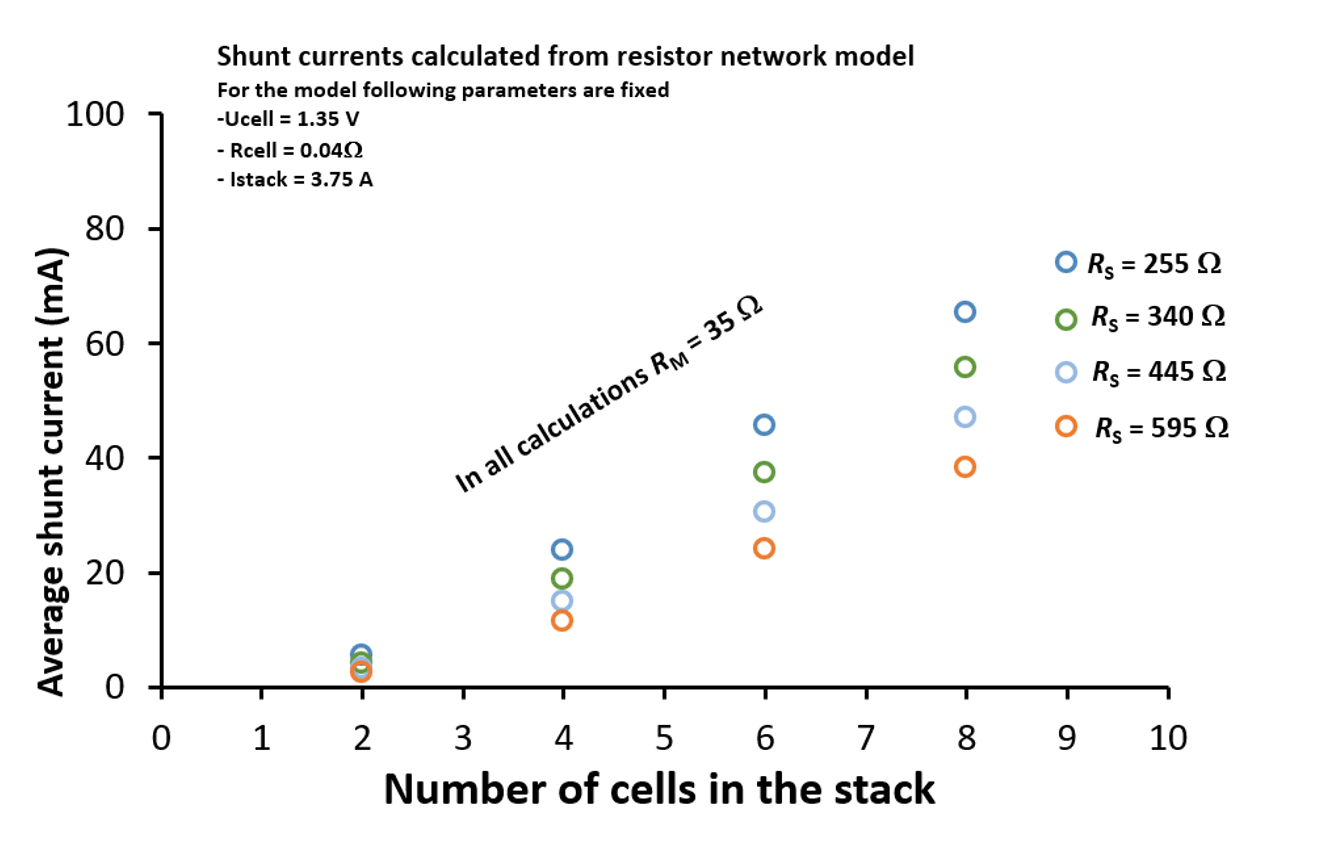
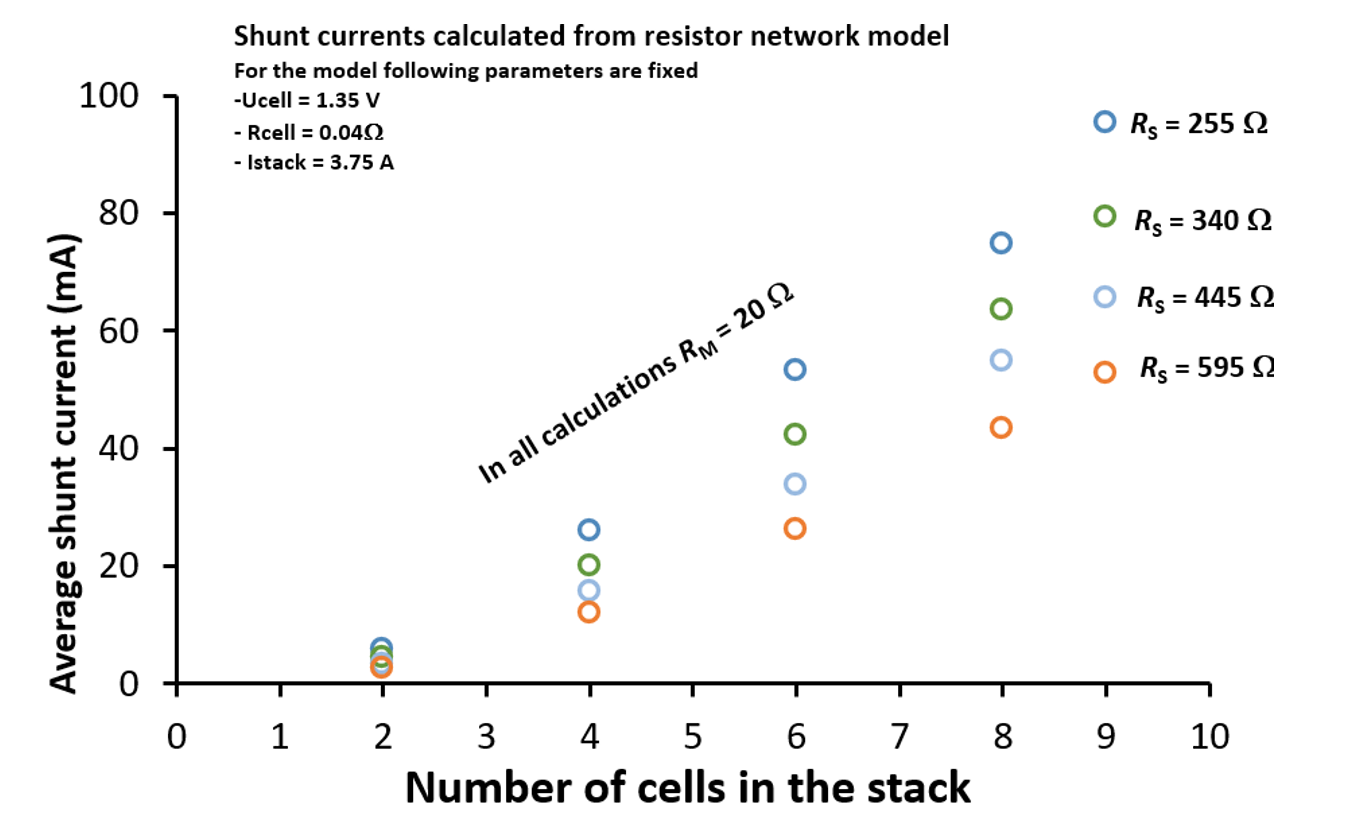
Figure 10. Modeled average shunt currents for different manifold resistances (Rm) and shunt channel resistances (Rs) as function of number of cells in the stack.
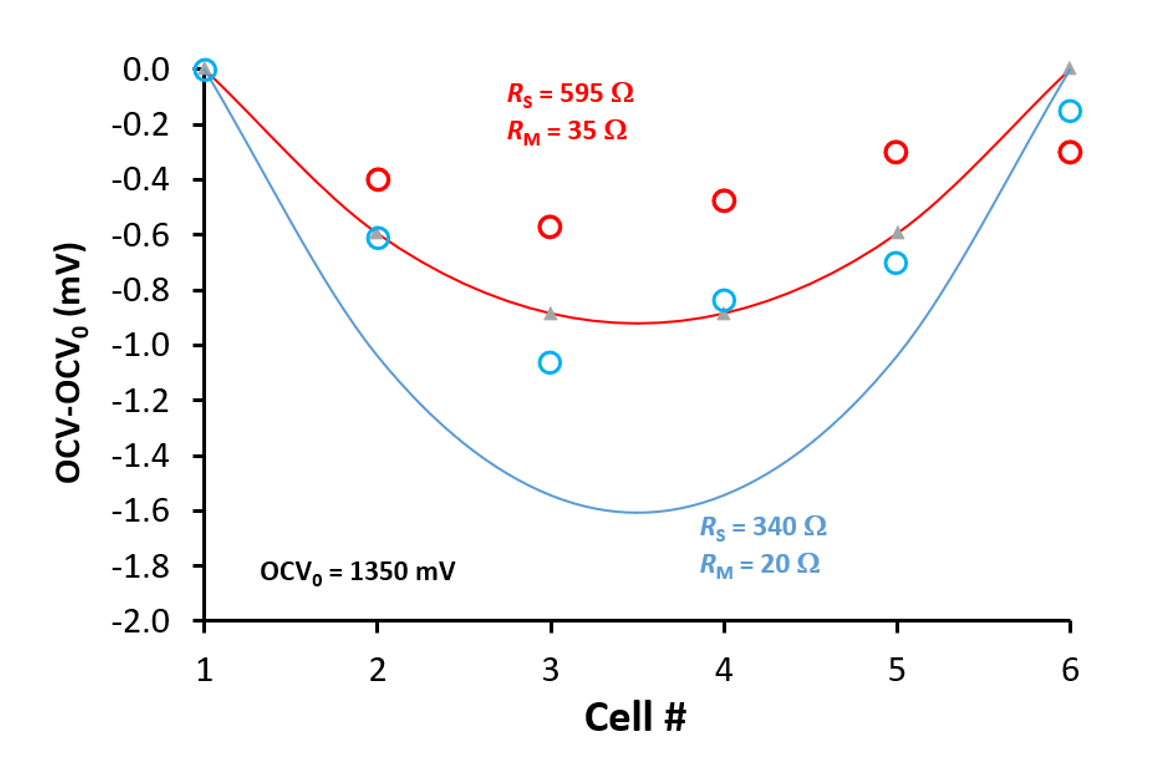
Experimental measurement of shunt current is challenging, nonetheless shunt current model can be used as indirect verification/comparison to experimental data. Here in particular the impact of shunt currents on the individual cell voltages can be both modeled and measured. In general, the center cells in the stack have lower potential than the over all OCV of the electrolyte and the outer cells of the stack. The effect is typically very small (for small cell numbers) and can in general not be observed during charging/discharging as small variations of individual cell resistance have larger impact than the shunt currents.
However, during stack OCV the effect of the stack current is not present. Figure 11 shows the modeled and experimental value of OCV-OCV0 of the individual cells and where OCV0 is the OCV of the electrolyte. It is shown for the two gasket cases from before, where it is seen that the modeling (solid lines) predicts slightly smaller potentials for the central cell that are about -0.9 mV and -1.7 mV lower for the central cells for configuration S2/M2-Rs= 340Ω / Rm= 20Ω and S1/M1 – Rs= 595Ω / Rm= 35Ω, respectively. The graph also shows the experimental values (open circles) that approximately track the experimental values, but overall slightly lower than the modeled values. It is emphasized that the experimental uncertainties are relatively large (± 0.4 mV), nonetheless experimental values are
systematically lower than the model. This is most likely related to difficulties of defining/ calculating correct Rs, where the resistance related to the triangular area just before the electrolyte enters the electrode in the flow field gasket (Figure 9) is not included in Rs.
Thus, the shunt currents for the different gasket cases in Figure 11 are therefore slightly overestimated.
Although the shunt current model as input requires, Rcell and Istack these parameters have little influence on the average shunt currents, as the shunt currents are primarily driven by the OCV of the cell and not the smaller overpotential during charge/discharge.
Overall, the modeling is intended as a support for understanding and dimensioning of gasket for Redox-flow.com stacks. I.e. for a stack with a specific
- Number of cells
- Electrical current
- Shunt channel size/resistance
- Manifold diameter/resistance
These values can be used for estimating the overall faradaic efficiency of the stack.
Effects of shunt currents through OCV cell
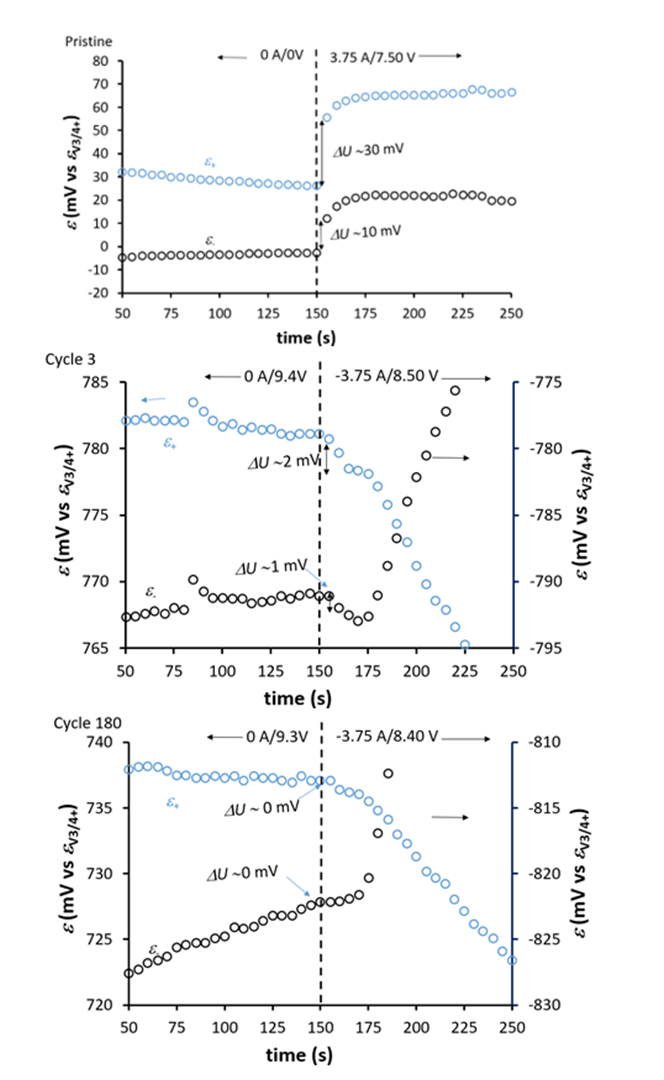
Finally, the bottom panel shows the same data but for cycle 180 (about 7 days after first cycle). In this case there is not observed any change of the response of the OCV cell when the stack voltage is changed. The OCV cell does not include a specific electrode material (like carbon felt) and it is the graphite body of the OCV cell that acts as the electrode. The progression of the response of the OCV cell can be explained by change of the internal resistance (Rocv) of the OCV cell. I.e. the resistance of the OCV hydraulic circuit (RHC, OCV) is so large (35 kOhm) that it determines the shunt current, whereby the OCV response scales with Rocv. Here two factors can explain the progression (i) The initial high response to shunt currents on pristine vanadium solution is a consequence of the redox reactions V3+→ V4+ and V4+ → V3+ are poorly catalyzed on graphite/carbon electrodes (in the OCV cell, the graphite body is used as electrode) and leads to a higher Rocv and explains the relatively large OCV response for the pristine solution (ii) additionally there is a clear tendency that the shunt current response of the OCV cell decreases with time (Rocv decreases with time). This is explained by the catalytic properties for vanadium oxidation/reduction of the graphite body of the OCV cell are improved with time and presumably by contact with the vanadium electrolyte.
Overall, the recommendations for the OCV cell are:
- The hydraulic resistance of the OCV cell can lead to significant pressure losses if flow rates are > 100 ml/min. For this reason it can be advantageous to create a separate hydraulic circuit for this. Here the multiport electrolyte reservoir is an enabler for this setup.
- If large erroneous responses of ε- and ε+ on the cell/stack current are observed, this can be minimized by increasing the length/resistance of the hydraulic circuit for the OCV cell. This minimizes shunt currents and thereby erroneous OCV responses.
- It is generally observed that erroneous shunt current responses decreases with time (presumably to increased catalytic activity of the graphite in the OCV cell). Therefore if large erroneous OCVs are observed, it is recommend to allow the OCV cell to ‘activate’ for a number of cycles or hours with flow and start test when it has reached a reasonable level.
Interested? We’d like to hear from you!
Don’t hesitate to contact us with any kind of inquiries at
sales@redox-flow.com or call Mikkel Kongsfelt at +45-3126-2040