
Introduction
Understanding and quantifying heat transfer in compact flow systems is essential for optimizing performance and reproducibility in thermal management and process design. This study focuses on evaluating the efficiency of two types of Redox Flow temperature control units under varying flow conditions: 1) a single-pass plate heat exchange operated using the single flow control unit, and 2) a continuous flow heat exchange operated using the double flow control unit. While the ideal configuration and performance depend on the specific application, the following work provides practical data, analysis, and guidance to support more informed design and operation of small-scale liquid heating systems.
The temperature control units
The Redox Flow heating & cooling units can be used for controlling the temperature of liquids and electrochemical cells – including flow batteries and electrolysers. To the best of our knowledge, similar products cannot be found by any other companies in the field.
Controlling temperature of cells and liquids for flow batteries, electrolysers and other electrochemical flow cells is challenging. One of the most widely used solutions is to place the cell and liquid bottles inside a heating chamber. While Redox-Flow has recommended this solution before (and still does, when it is viable), it comes with several limitations and shortcomings:
- Most commercial heating chambers do not come with feed-through holes for electrical wires to the cell and must be drilled manually
- For high temperature operation, the pump must be placed outside the heating chamber and can result in long hydraulic connections
- In heating/cooling chambers the space is limited and setting up experiments becomes tedious and time consuming
- Chambers with both heating and cooling are in general very costly
- Due to limited thermal conductance through bottles and cells, the time for reaching the set point temperature can be long (> 1-2 hours)
The solution developed by Redox-Flow.com comes in three different configurations that are based on the same components and can be interchanged depending on the purchased option (upgrading is always possible). All options include a PEEK flow body and metal block, shown in the pictures below. The PEEK body contains one (variant 1) or two separate (variant 2) flow chambers for heating/cooling one or two independent liquids, respectively. The liquids in the experimental setup are circulated through the PEEK flow body and placed against a metal heating/cooling plate, whereby heat is transferred to or from the liquids in the PEEK flow body. The metal plate is separated from the liquids in the experimental setup by a thin PTFE sheet, whereby corrosive/oxidative solutions can also be heated without corroding the metal plate. At the time of the studies, the material of the heating block was aluminium.
The aluminium block can be 1) heated by placing it on a heating plate, or 2) heated or cooled using heat cartridges for liquids and thermometers.
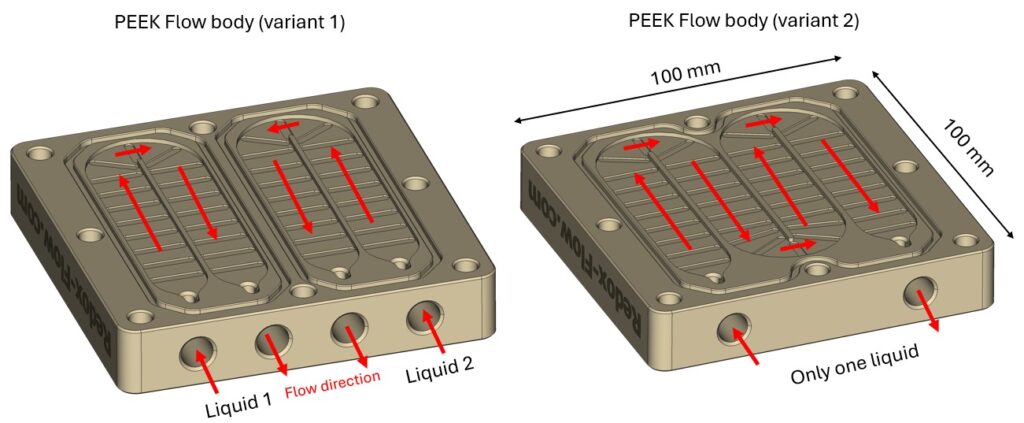
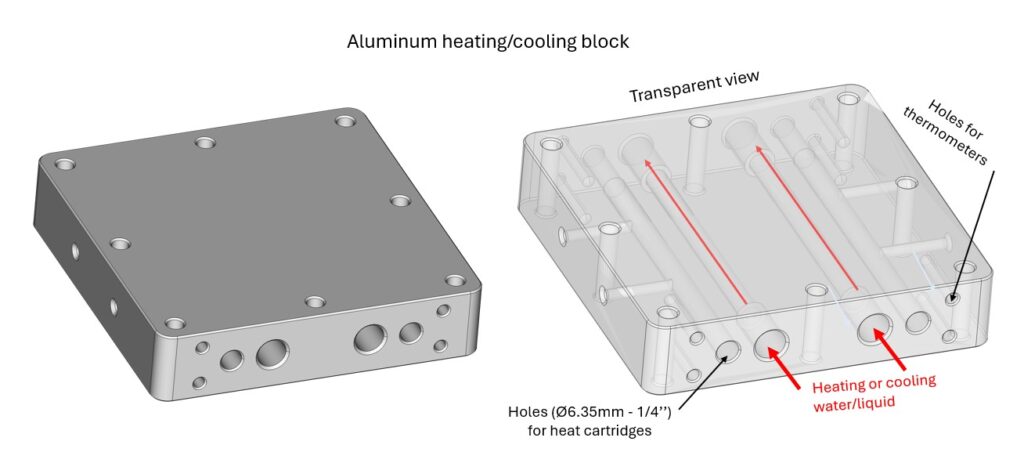 There are three options for the heating/cooling unit. For all products, the temperature can be controlled by circulating heating/cooling liquids through the metal block or by using a heat cartridge in the metal block. In two of the products, the temperature can also be controlled by placing the unit on a heating plate.
Study 1: Single-Pass Heat Exchange Using The Single–Flow Temperature Control Unit
Experimental setup
The experiment was performed using a peristaltic pump, a Redox Flow single-flow temperature control unit with an aluminum plate, a temperature-controlled heater, and two digital thermometers. Water was used as the working fluid and passed once through the control unit (non-recirculating flow).
The heater temperature was set to 80 °C, 100 °C, and 120 °C, while the flow rate was varied at 4, 8, 12, and 20 mL/min. The inlet fluid temperature (TF) was maintained at approximately 20 °C throughout the experiments.
The following temperatures were recorded:
- TF : temperature control unit liquid inlet temperature
- TE : temperature control unit liquid outlet temperature
- TA : temperature of the aluminum plate
These measurements were also used to calculate the overall heat-transfer coefficients (U) and to evaluate the efficiency of the single-flow temperature control unit under different operating conditions.
Results
Three graphs were prepared to illustrate the relationship between the outlet temperature (TE) and the flow rate for each heater setting. Each graph corresponds to one of the tested heater temperatures of 80 °C, 100 °C, and 120 °C, and shows how the outlet temperature decreases as the flow rate increases. This trend reflects the reduced residence time of the water in contact with the heated surface at higher flow rates.
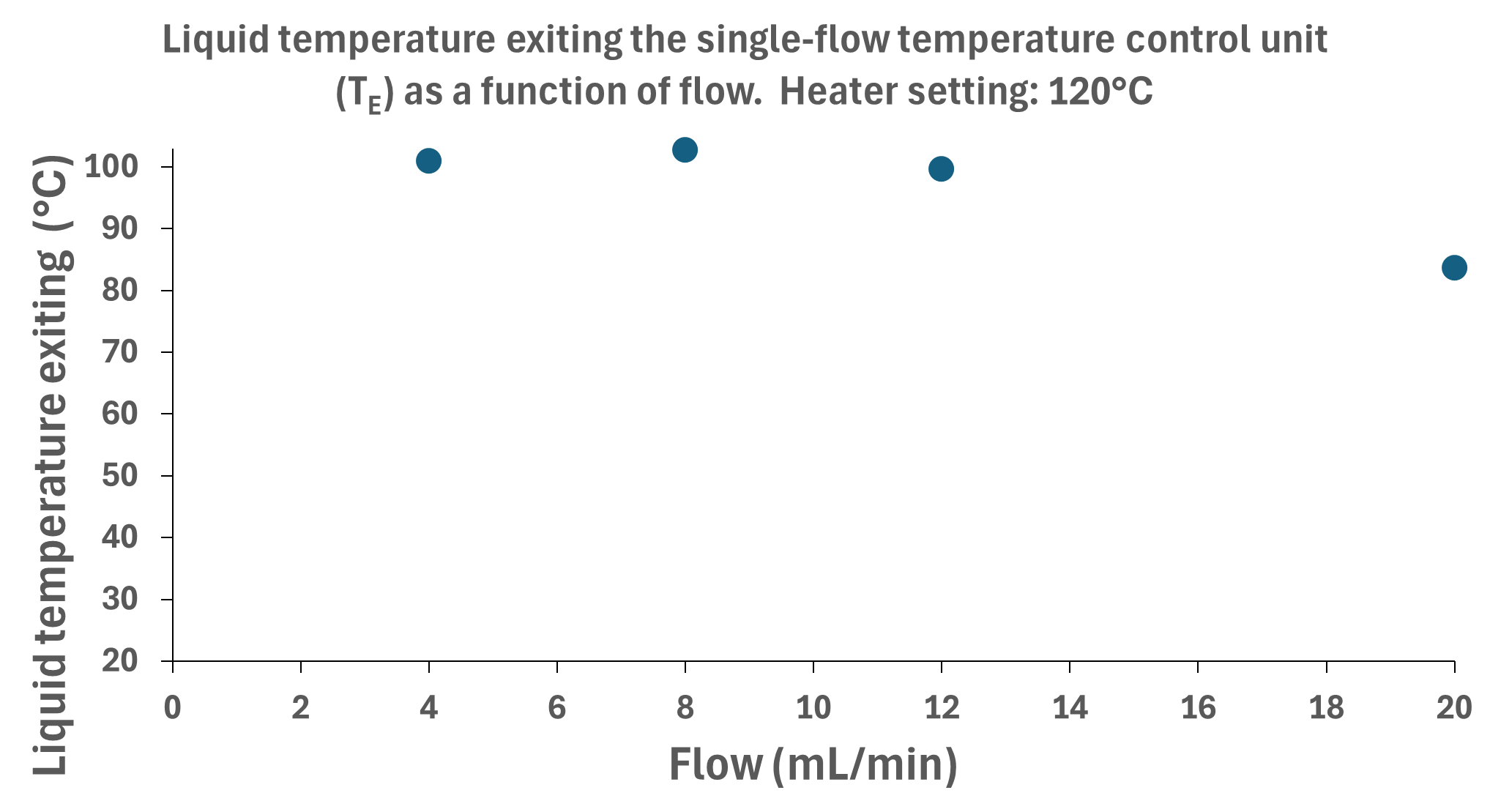
Figure 1
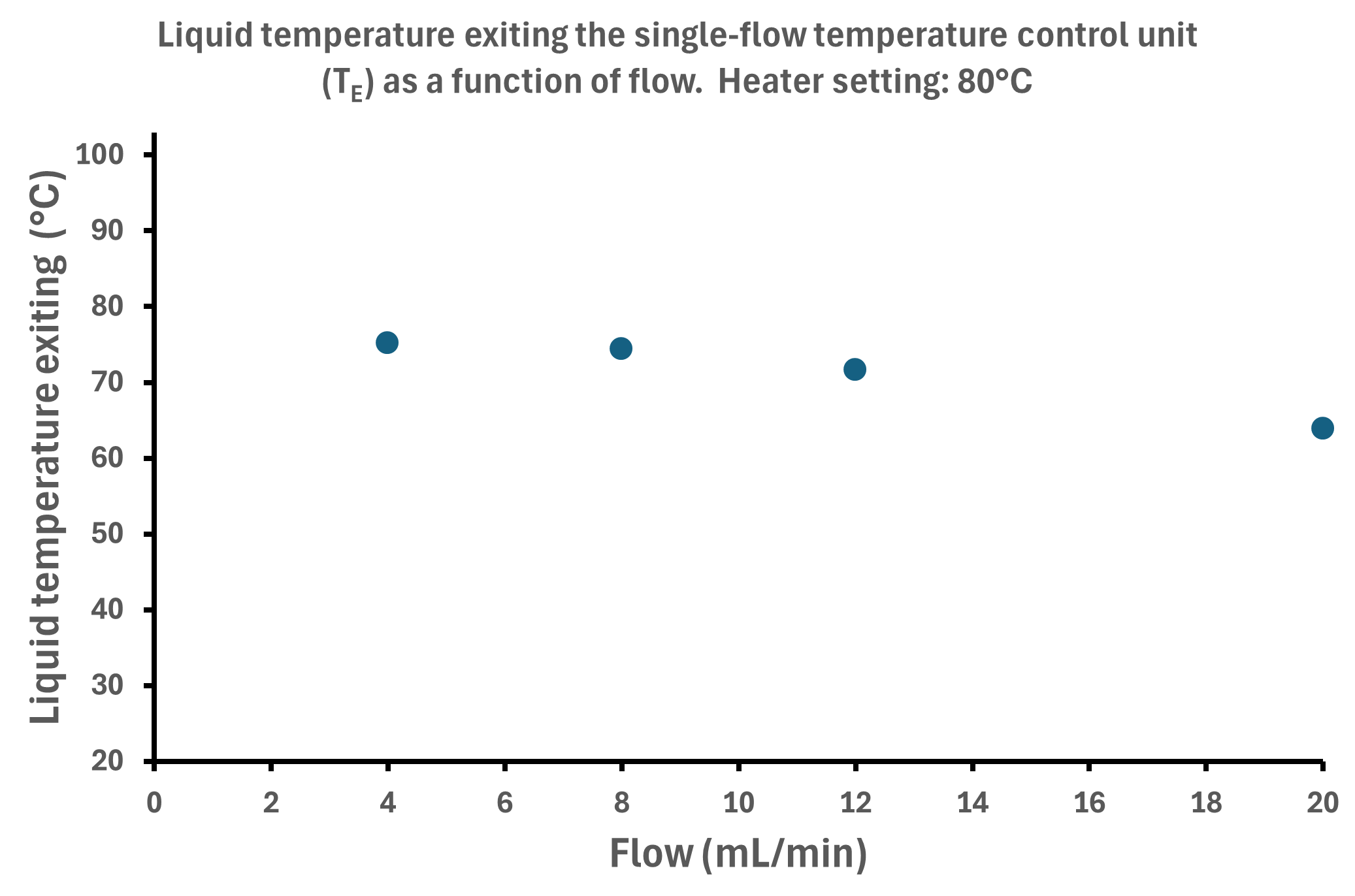
Figure 2
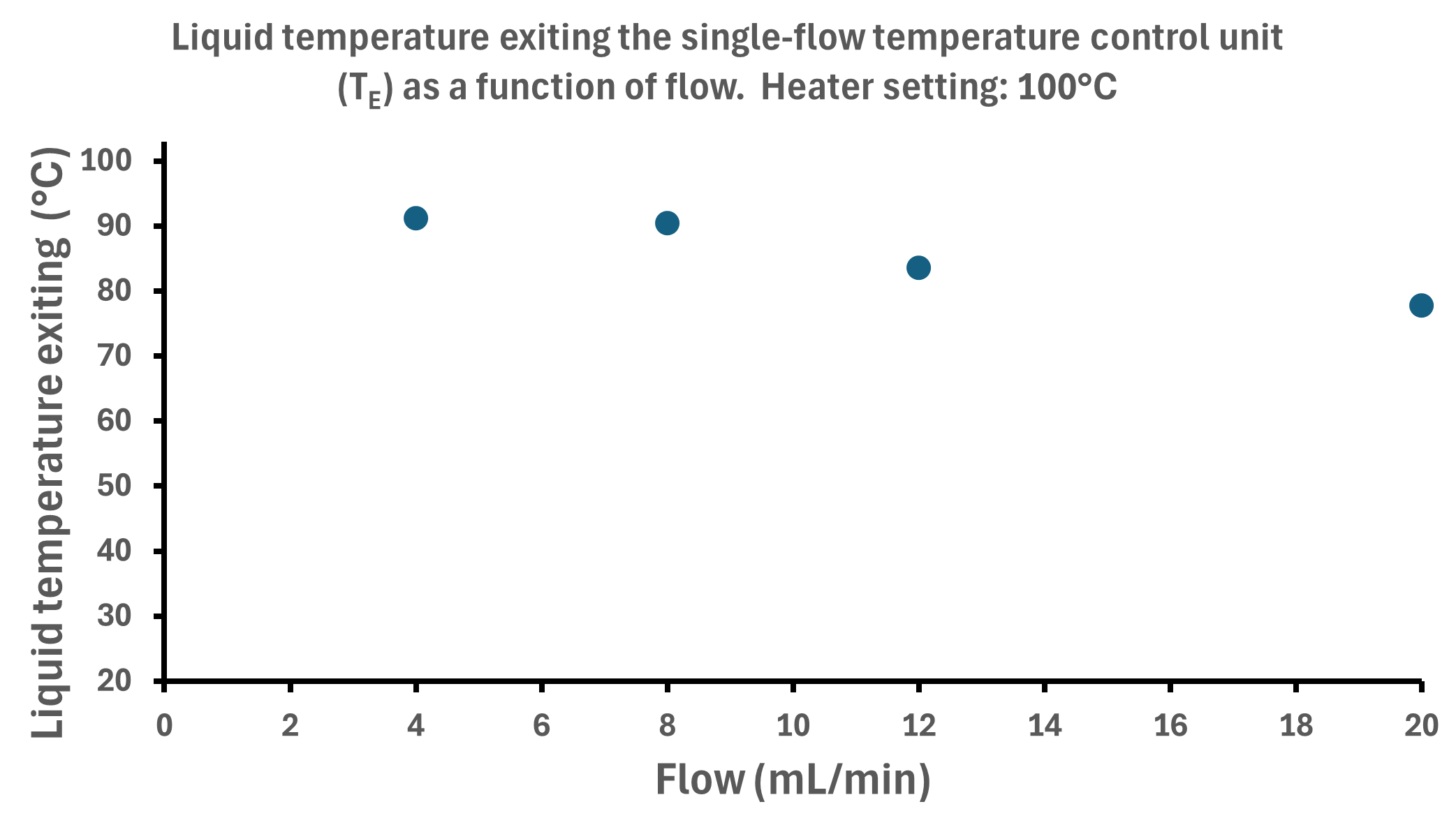
Figure 3
The graph below shows the heat transfer coefficient between the aluminum block and the liquid at three different heater settings. The coefficients can be used for estimating the heat transfer power between the unit and the liquid.
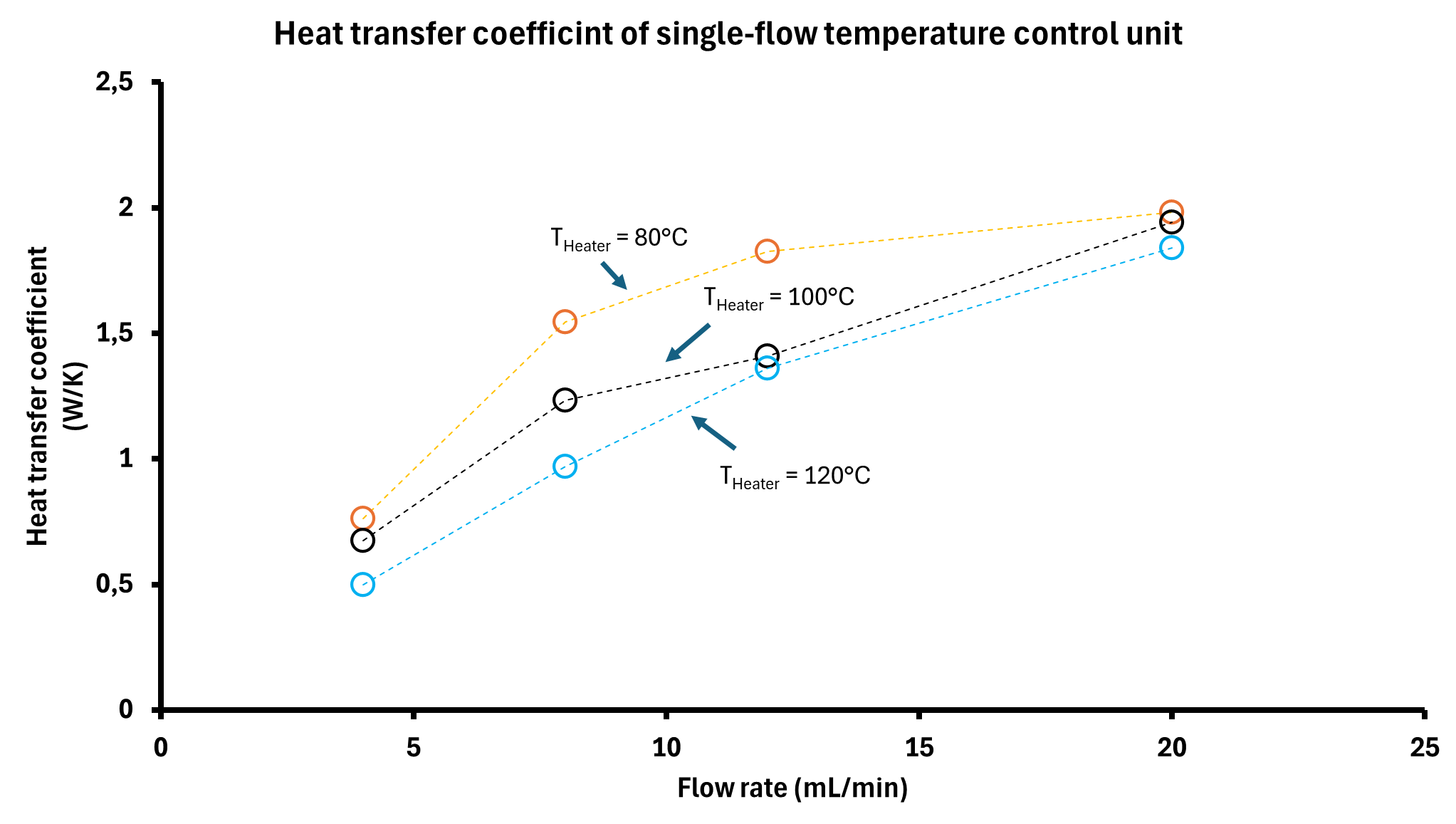
Figure 4




Thus, at a heater setting of 100 °C, a flow rate of approximately 17,35 mL/min results in an exiting liquid temperature of 80 °C.
Study 2: Continuous Flow Heat Exchange Using The Double Flow Temperature Control Unit
Experimental setup
The experiment was performed using a peristaltic pump, a double–flow temperature control unit with an aluminum plate, a temperature-controlled heater, and two digital thermometers. Water was used as the working fluid and passed continuously through the temperature control unit (recirculating flow).
Results
Heat Transfer Coefficient
Graph below shows the heat transfer coefficient between the aluminum block and the liquid. It is measured by heating about 500 mL of water in a bottle (without an electrochemical cell) by placing the heating unit on a heating plate where the aluminum block temperature is fixed and the temperature in the bottle is monitored.
The heat transfer coefficient is in the range 1 W/K to 5 W/K and dependent on the flow rate. We term the coefficient ‘apparent’ as it does not strictly follow the definition of the ‘overall heat transfer coefficients’. Nonetheless, the coefficients can be used for estimating the heat transfer power between the unit and the liquid. I.e., if there is a 40 K temperature difference between the aluminum block and the liquid and the flow rate is 100 mL/min, it can be expected that 100 W of heat is transferred.
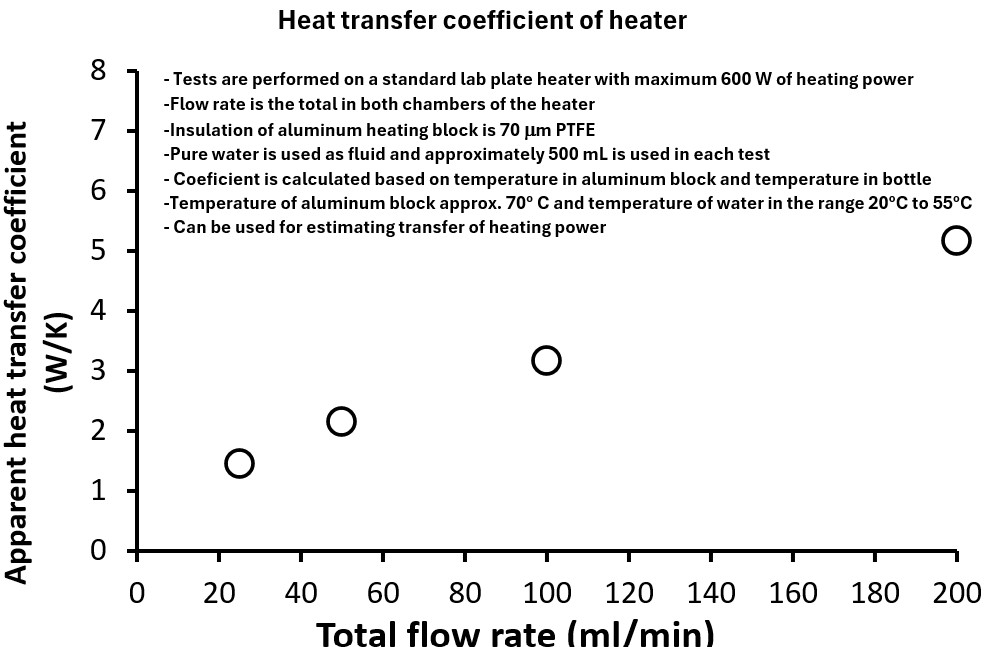
Figure 5
Bottle Heating
Graph below shows a configuration where the unit is placed on a heating plate and connected to a pump and a bottle with 500 mL of water (i.e., an electrochemical cell is not included in the circuit). The heating plate has a maximum of 600 W heating power and PID control, where the input for the control is an external thermometer, which in this case is placed in a bottle. In addition to this thermometer, one is also placed inside the aluminum block. In this test, the water temperature set-point in the bottle was set at 75°C. It is seen that the water reaches 75°C within 15 minutes and stability is reached within about 35 minutes. Better control strategies can shorten time before stability.
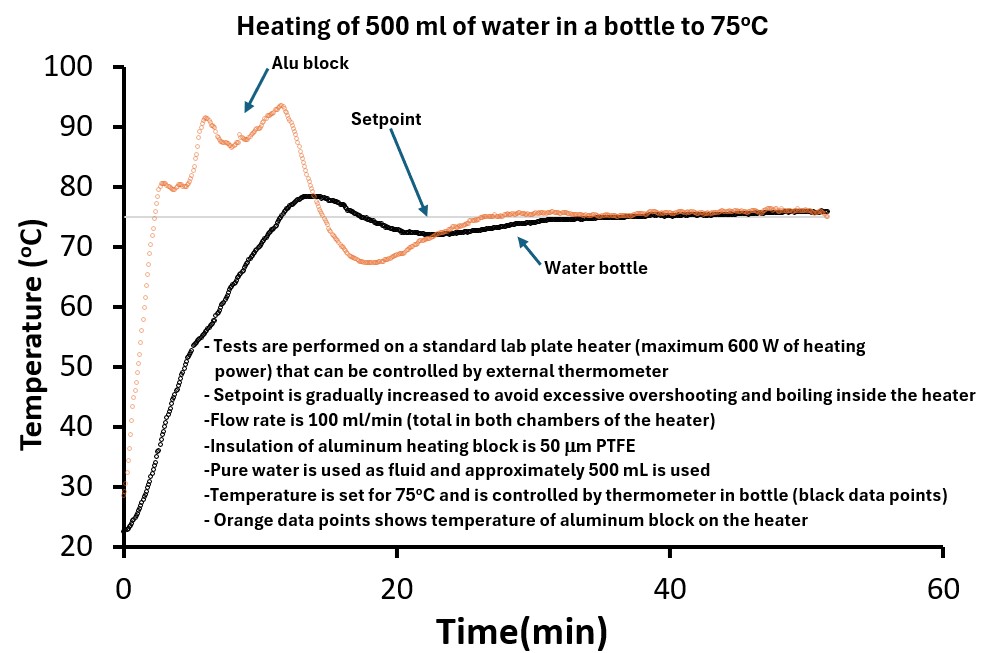
Figure 6
Cell & Bottle Heating
Graph below shows a configuration where the unit is placed on a heating plate and connected to a pump. The heating unit is placed after the pump and followed by an electrochemical cell and a bottle. The total water volume is 500 mL. The heating plate has a maximum of 600 W heating power and PID control, where the input for the control is an external thermometer. In this case, the control thermometer is placed inside the cell (close to the current collector). Temperature stability is reached within about 35-45 minutes. More aggressive temperature control strategies where temperature over shooting is allowed will decrease time to reach the temperature set-point.
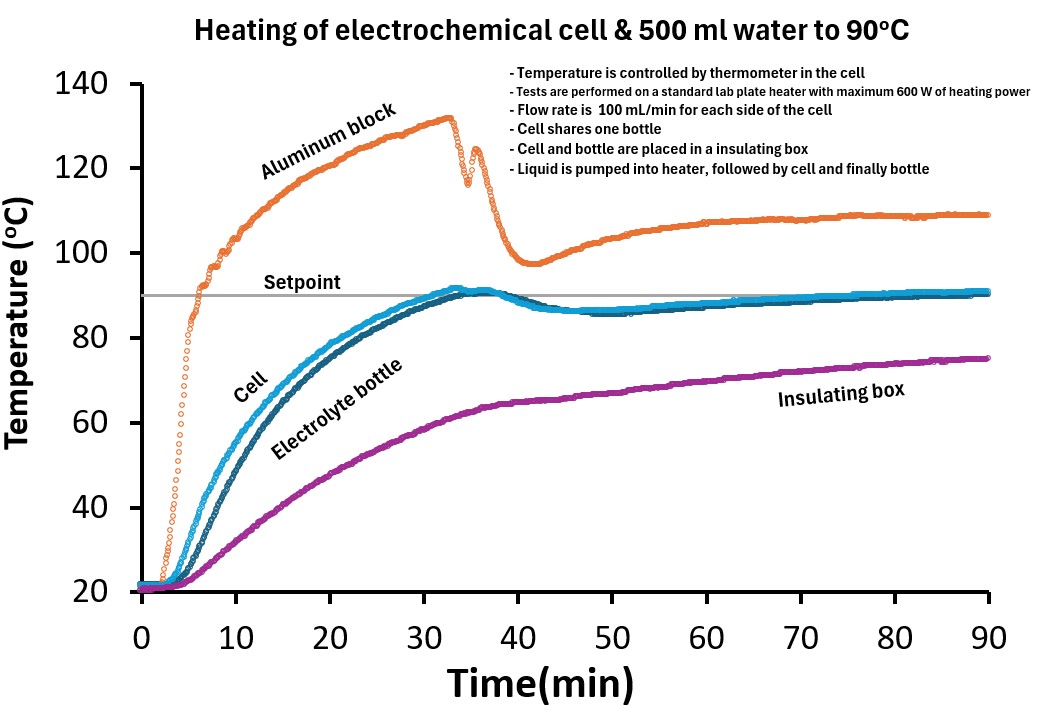 Figure 7
Interested? We’d like to hear from you!
Don’t hesitate to contact us with any kind of inquiries at
sales@redox-flow.com or call Mikkel Kongsfelt at +45-3126-2040

Mikkel Kongsfelt